
Chukar in California
The chukar partridge (Alectoris chukar): an Asian bird long since gone wild in the steepest, driest, rockiest country California's upland hunters ever walk.
Chukar is the California bird people organize whole autumns around and then describe in the language of penance — the climb, the wind, the covey that got up 200 yards out and went over the rim. Peter grew up hunting chukar on the Nevada side of the Sierra — the same bird and the same lungs-and-knees arithmetic, one range over. On the California side we are still learning the ground, and this page says where the knowledge is ours and where it is reported.
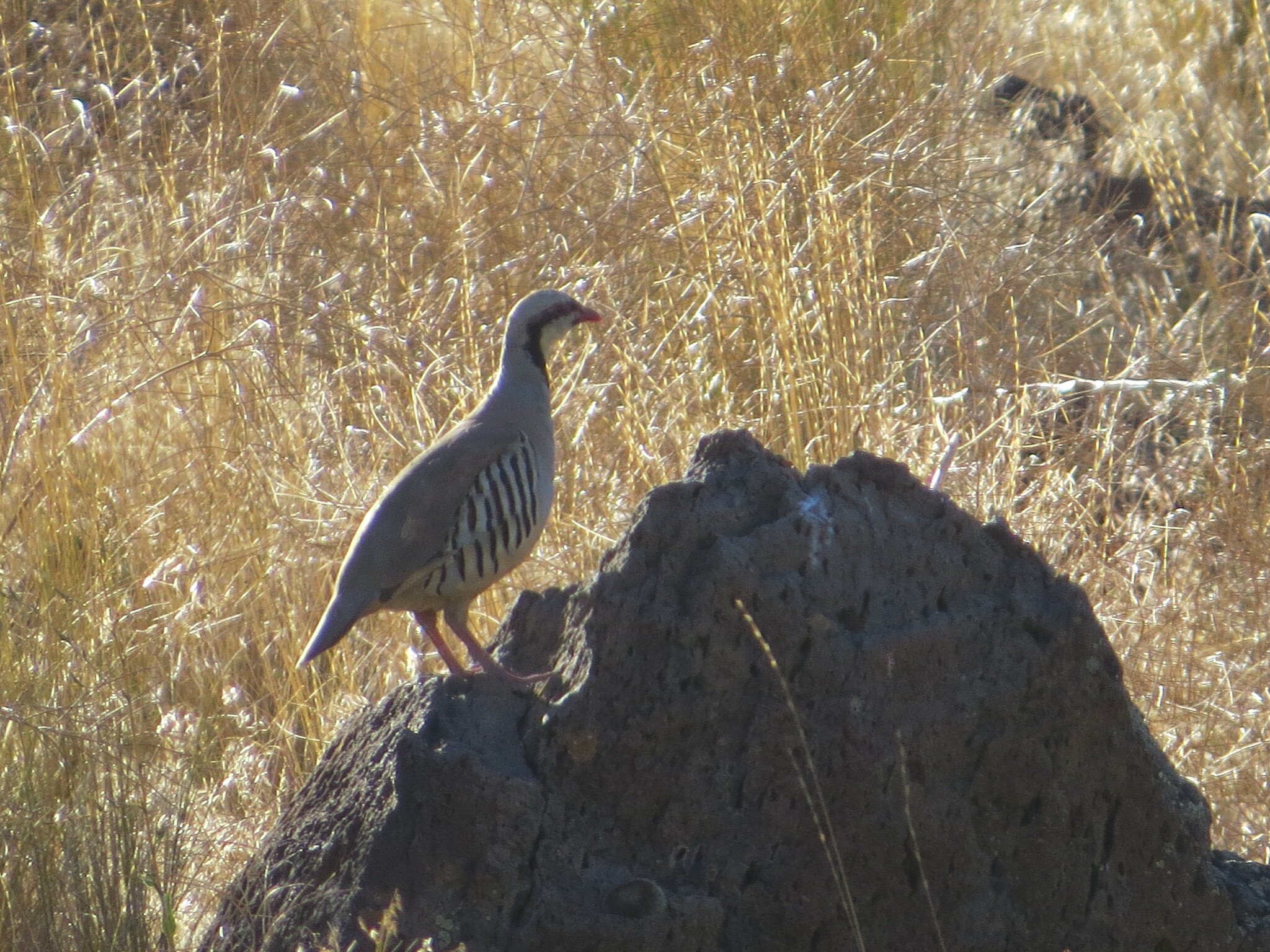
A chukar on basalt above cheatgrass in Modoc County in August. Photo: Garth Harwood / CC BY 4.0 — source
2026–27 Season at a Glance
Dates: Saturday, Oct. 17, through Jan. 31, statewide. One general season, no zones.
Daily bag: six chukar. Possession is triple the daily bag.
Shooting hours: one-half hour before sunrise to sunset.
Paperwork: a California hunting license and the upland game bird validation (not required on a junior license). HIP is not required for chukar.
Shot: nonlead only, statewide.
Checked against CDFW's 2026–27 seasons and limits on Oct. 7, 2026. Archery and falconry seasons run separately; the CDFW upland game bird page is the authority.
Know the Bird
Chukar were introduced to the West from central and southwest Asia beginning in the 1930s, and California's birds have sustained themselves in the wild for more than half a century. They are handsome and solid in the hand — 19 to 27 ounces — with a gray-brown back, a buff belly, bold vertical black bars on the flanks, a black mask running through the eye and around the throat, and a red bill and red legs. Males and females look alike, so there is no sexing one in the air.
Coveys form by August and hold through the season, usually 10 to 25 birds. The chuk-chuk-chukar call carries across a canyon, and males call from high perches at dawn and dusk in spring, which makes a still morning on a ridge the cheapest scouting there is. The daily rhythm is the whole game: at first light birds drop off the roost toward water, feed the wetter margins, then walk uphill as it warms and loaf in shade for hours. First and last light are when they are predictably moving at a height you can reach.
Where They Live in California
Hunters took a little under 31,000 chukar in 2023–24, and the northeast dominates — Lassen County alone reported 13,738 (CDFW harvest survey). Three regions hold the birds:
The Eastern Sierra and the Owens Valley. Inyo and Mono counties, from the east face of the Sierra across to the White and Inyo mountains. Steep, treeless sage and bitterbrush country, mostly BLM land managed out of the Bishop Field Office.
The Modoc Plateau and northeast California. Modoc, Lassen, and northern Siskiyou counties: basalt rims and sage-steppe from 4,500 to 6,500 feet, BLM land out of the Eagle Lake and Applegate field offices, and the Modoc National Forest above.
The desert ranges of the southeast. The higher, wetter mountain ranges of San Bernardino, southern Inyo, and eastern Riverside counties. Remote, with water scarcer and populations thinner. Death Valley National Park, like the other national parks in California, is closed to hunting.
The template under all three is the same: water, steep and broken escape cover, and the band of slope where the cheatgrass and forbs grow, all close together. In the dry months that water is springs, seeps, creeks, and the guzzlers CDFW and BLM have built across this country — and those guzzlers need volunteer maintenance hours every spring. Cheatgrass is both the bird's main food and the fuel that burns out the sagebrush it shelters in; our map's fire layer shows where that has already happened.
How It's Hunted
Water first is the most repeated advice in every California chukar source we've read. Past that, this is what the accounts describe:
Find the water before you leave home. Springs on the topo, perennial creeks, and mapped guzzlers locate the likely coveys in the dry months. Mapping Chukar Water in the Off-Season has the method.
Walk the band on contour. Chukar sit in a strip a few hundred vertical feet wide between the loafing cover above and the water below, and hunters describe walking along it rather than up and down the slope.
Get above them. Pressured chukar run uphill. Hunters coming from above push birds down the band, where they reportedly hold tighter and flush downhill in range.
Glass, then walk. Optics come up more for chukar than any other California upland bird. Our glassing piece covers what earns its weight.
Pace yourself and the dog. Rock, cheatgrass, and October heat at elevation are hard on dogs; water for the dog is not negotiable, and pads need conditioning from late spring.
The honest limit of all of it: nothing secondhand tells you which drainage holds birds this October. Research narrows a mountain range to a canyon. Only boots and a bad morning narrow a canyon to a slope.
Start Here
Planning a First Trip to Owens Valley Chukar Country. What we found in the research, and what we'll find out on the ground.
Planning a Modoc Plateau Chukar Hunt: A NorCal Scouting Guide. Rim country, sage-steppe, and access in the northeast.
Planning the 2026–27 California Quail and Chukar Season. Dates and limits in one table.
Our full chukar guide publishes Oct. 8 and will lead this page.
Everything We've Written on Chukar
Mapping Chukar Water in the Off-Season: A NorCal Hunter's Approach
Glassing Optics for California Chukar: What to Look for in Binoculars Before You Climb
Reading Recent Burns for Birds: The New Fire Layer on California's Upland Map
The Hill You Don't Climb: Off-Road Driving Skills for California Hunting Access
What I Carry for Alan: A California Bird-Dog Kit That Actually Works
Nonlead Ammunition for California Upland Hunters: 2026–27 Supply Planning
Reading California's Upland Harvest: A County Map of Where the Birds Were Taken in 2023–24
Further reading: Cornell's chukar account, and our county Harvest Map.
Other California Upland Birds
Doves · Quail · Pheasant · Sooty and ruffed grouse · Band-tailed pigeon · White-tailed ptarmigan · Wilson's snipe · All species
One email each Sunday: what opened, what we published, and what we're working on. Subscribe to the weekly digest.
Photo credit: chukar, Modoc County — Garth Harwood / CC BY 4.0 — source