
White-tailed Ptarmigan in California
The white-tailed ptarmigan (Lagopus leucura): an alpine grouse brought to the Sierra Nevada in the early 1970s, with a nine-day September season and a limit of two birds for the whole year.
California's ptarmigan are not native. Wildlife managers released birds from the Rocky Mountains into the central Sierra in 1971 and 1972, and they took to the alpine country along the crest — boulder fields, willow, and late snowbanks above 10,000 feet. Few California upland hunters ever go looking for one. We haven't yet either, so this page is a planning sheet: the rules, the bird, and what the agencies that study it say about finding it.
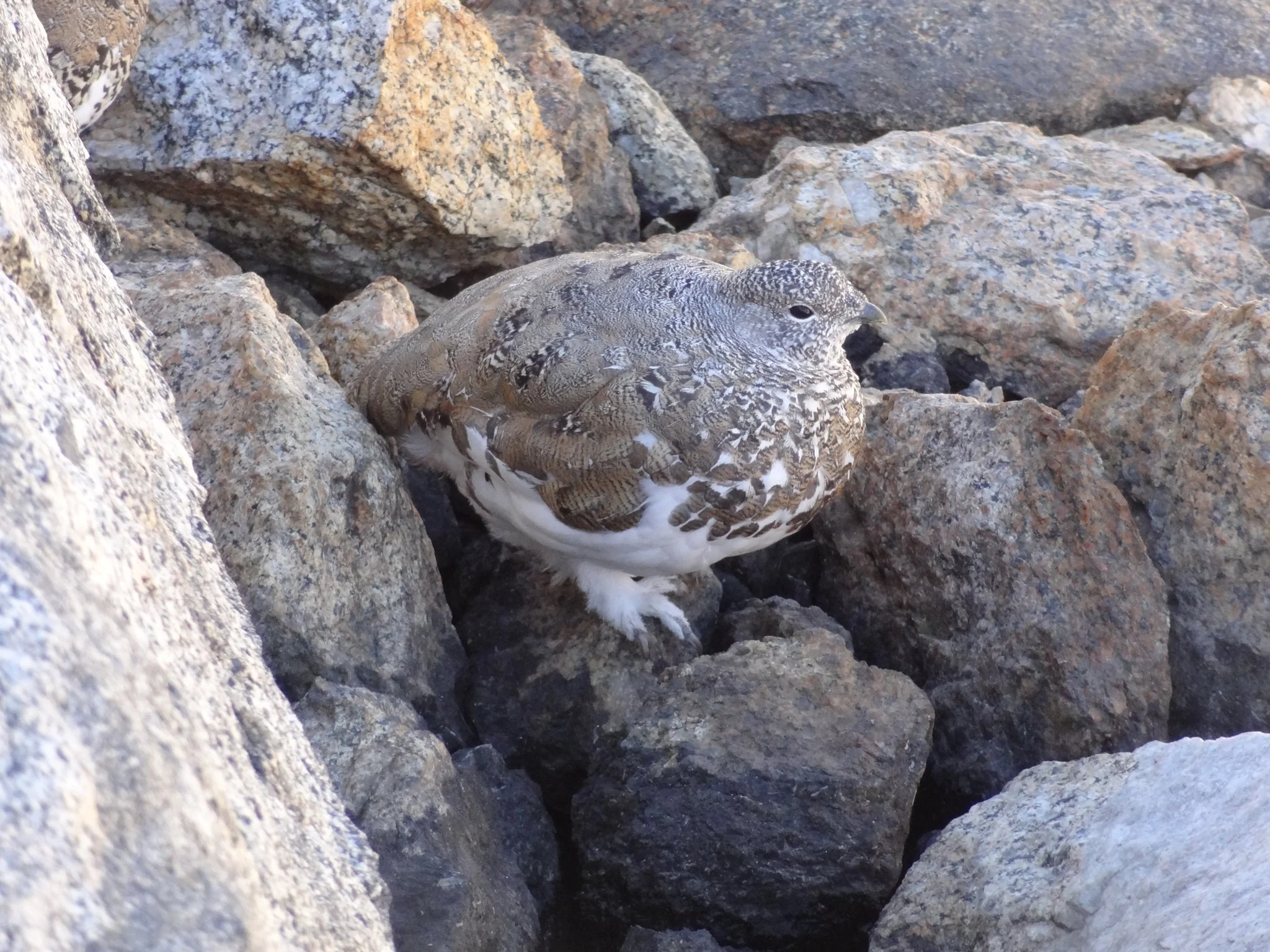
A white-tailed ptarmigan in early-September molt among Sierra granite in Mono County. Photo: Christoph Moning / CC BY 4.0 — source
2026–27 Season at a Glance
Dates: Sept. 12–20, statewide.
Bag: two a day, and two for the season.
Shooting hours: one-half hour before sunrise to sunset.
Paperwork: a California hunting license and the upland game bird validation (not required on a junior license).
Shot: nonlead only, statewide.
Checked against CDFW's 2026–27 seasons and limits on Oct. 7, 2026. The CDFW upland game bird page is the authority.
Know the Bird
The white-tailed ptarmigan is the smallest grouse in North America, about three-quarters of a pound. From spring through fall it is mottled gray-brown with white wings, belly, and tail that flash when it flushes; in winter it turns entirely white. By the September season the birds are partway into their winter feathers, patchy brown and white like the bird above.
The one to separate it from is the sooty grouse, which is in season the same week in the same mountains. A ptarmigan is about a third the size, with a white tail; a sooty grouse is much darker, with a dark tail ending in a gray band. Ptarmigan live above the trees, and sooty grouse in them.
Where They Live in California
The introduced population lives along the Sierra crest, centered on the alpine country of Mono County on the Inyo National Forest, roughly 10,000 to 12,000 feet, and birders have since recorded them along the crest to the south. Summer food there is almost entirely willow and sedge. Much of this country is federal wilderness, which is open to hunting under state rules but closed to vehicles and bikes, and much of it is national park, which is closed to hunting altogether. Our public land designations guide explains both.
How It's Hunted
We have no ptarmigan days of our own. Here is what the agencies describe:
Look for green late in the summer. Wildlife biologists in Utah, where ptarmigan were also introduced from Colorado, find late-summer birds around the heads of streams, springs, and the bottoms of late snowfields, especially where that green meets a talus slope or rock field.
Look for sign. Piles of brown droppings at the bases of willows and rocks are the giveaway.
Pack out your hulls. Spent shells last for years above the trees and are easy to spot, Utah's biologists note.
Our own planning note, not the agencies': the Sierra study birds lived between about 10,000 and 12,000 feet, so this is a full alpine day, and the walking is most of it.
The caveat is plain: a two-bird season limit and a nine-day window make this a once-in-a-while adventure, not a season. It also makes it one of the more remarkable birds a California hunter can carry down a mountain.
More from California Upland
Hunting the Overlap: Sooty Grouse, Band-Tails, and Quail in the High Sierra in September
The Hill You Don't Climb: Off-Road Driving Skills for California Hunting Access
Further reading: Cornell's white-tailed ptarmigan account and Utah's guide to locating white-tailed ptarmigan.
Other California Upland Birds
Doves · Quail · Pheasant · Chukar · Sooty and ruffed grouse · Band-tailed pigeon · Wilson's snipe · All species
One email each Sunday: what opened, what we published, and what we're working on. Subscribe to the weekly digest.
Photo credit: white-tailed ptarmigan, Mono County — Christoph Moning / CC BY 4.0 — source