
Band-tailed Pigeons in California
The band-tailed pigeon (Patagioenas fasciata): California's only native wild pigeon, a fast oak-and-conifer bird with two short seasons — one in the north in September, one in the south in December.
Most California upland hunters have walked under a band-tailed pigeon without knowing it. The bird sits high and gray in a live oak or a fir, then leaves the tree like it was thrown. In September Peter took one in the Sierra above Hope Valley, out of the grouse cover we were walking, with Alan working ahead — the bird that came home from a grouse trip. It is a bird few hunters pursue on purpose, and one that rewards the ones who learn its calendar.
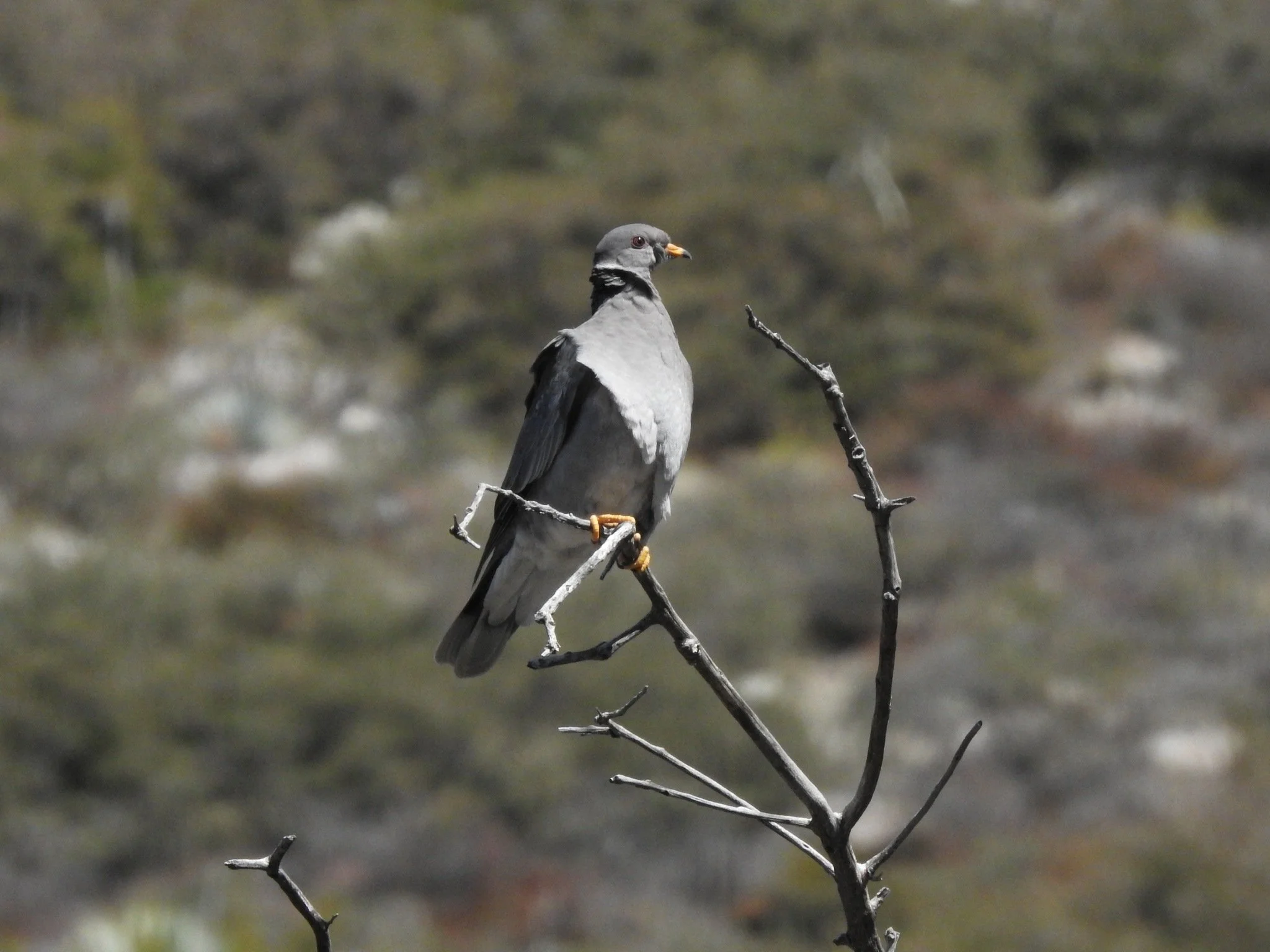
A band-tailed pigeon above chaparral and oak in San Bernardino County. Photo: Andy Kleinhesselink / CC0 — source
2026–27 Season at a Glance
North Zone: Sept. 19–27. The North Zone is Alpine, Butte, Del Norte, Glenn, Humboldt, Lassen, Mendocino, Modoc, Plumas, Shasta, Sierra, Siskiyou, Tehama, and Trinity counties.
South Zone: Dec. 19–27, everywhere else in the state.
Daily bag: two band-tailed pigeons. Possession is triple the daily bag.
Shooting hours: one-half hour before sunrise to sunset.
Paperwork: a California hunting license, the upland game bird validation (not required on a junior license), and the free HIP validation — band-tails are a migratory bird.
Shot: nonlead only, statewide.
Checked against CDFW's 2026–27 seasons and limits and its band-tailed pigeon zone map on Oct. 7, 2026. Nine days a zone is not much; the CDFW upland game bird page is the authority.
Know the Bird
A band-tail is bigger and longer-tailed than a city pigeon, gray with a purplish wash on the breast, and three things settle the ID in the hand: a yellow bill with a dark tip, yellow feet, and a pale gray band across the end of the tail. Adults also carry a white crescent on the back of the neck above a patch of iridescent green. A feral rock pigeon has a dark bill, pinkish-red feet, black bars on the wing, and usually a white rump.
In the air, the bird to separate it from in September is the sooty grouse, because the two feed on the same berries along the same timber edges. A band-tail climbs out over the trees on pointed wings and keeps going; a grouse gets up with a whirr on round wings and drops back into cover.
This is California's only native pigeon and a close relative of the extinct passenger pigeon, and it reproduces slowly: one egg per nesting attempt, and most years a single chick. The Pacific Coast population has declined over the long term — about 2 percent a year since 1968 on the Breeding Bird Survey, by CDFW's account — which is why the seasons are nine days long, the bag is two, and the bird is watched closely by CDFW and the U.S. Fish and Wildlife Service. They follow food: berries as they ripen from summer into winter — elderberry and cascara, then madrone and toyon — and acorns through fall and winter. They also visit mineral springs, and biologists count them there each summer to track the population.
Where They Live in California
Band-tails live in oak woodland and mixed conifer forest in the Coast Ranges and the Sierra Nevada — mostly the west slope, though Peter's bird came from just east of the crest — and south through the mountains of Southern California into San Diego County. They avoid the Central Valley floor and the deserts. In the north that means canyon live oak, black oak, madrone, and Douglas fir ridges — the same country that holds mountain quail and sooty grouse. In the south it means oak canyons and the conifer belts of the Transverse and Peninsular ranges.
The two zones follow the birds. Many band-tails breed in the conifer forests from Northern California to British Columbia, then winter in central and southern California alongside resident birds. The North Zone's September week comes before most of that movement; the South Zone's December week comes when the wintering flocks are on the acorns.
Where they are on a given week depends on food more than place. Harvest data is thin because so few hunters chase them: the 2023–24 survey turned up band-tails from Humboldt to San Diego, but too few reports to estimate any single county. Our Harvest Map marks the counties where hunters reported them.
How They're Hunted
We have one September of our own with this bird, so most of what follows is what the hunters we've read describe:
Follow the food. In the North Zone in September, that is ripening berries and the first acorns along timber edges; in the South Zone in December, it is acorn mast in oak canyons.
Learn the flight lines. Band-tails move between roost, feed, and water on a schedule, and the accounts describe hunters waiting on a ridge or saddle along that line rather than chasing birds through the canopy.
Carry a little more gun. Band-tails are big, fast, and often high; hunters describe heavier nonlead loads than they'd shoot at dove.
Check your validations. Band-tails need HIP on top of the license and upland validation; grouse don't. In the North Zone the band-tail week falls inside grouse season, so carry all three if you're hunting both.
The caveat: nine days is short, and a band-tail week that misses the berries or the acorns can come up empty no matter how good the hunter. When it lines up, it's dark, rich meat and a bird worth a proper dinner.
One more thing hunters can do for this bird: band-tails suffer periodic winter die-offs from a parasitic disease, avian trichomonosis, and CDFW asks for reports of sick or dead pigeons. If you find them, tell the department.
Start Here
Hunting the Overlap: Sooty Grouse, Band-Tails, and Quail in the High Sierra in September. Our September trip, and the band-tail that came home.
Band-tailed Pigeon: California's Overlooked Upland Migrant. The bird's range, food, and biology.
More for Band-tail Country
Sooty Grouse Spring Scouting in NorCal: Hooting, Habitat, and a Plan for Fall
From a Dove Field Back to Quail: Peter Burnham on The Upland Social
Reading California's Upland Harvest: A County Map of Where the Birds Were Taken in 2023–24
Nonlead Ammunition for California Upland Hunters: 2026–27 Supply Planning
Further reading: CDFW's band-tailed pigeon page and Cornell's band-tailed pigeon account.
Other California Upland Birds
Doves · Quail · Pheasant · Chukar · Sooty and ruffed grouse · White-tailed ptarmigan · Wilson's snipe · All species
One email each Sunday: what opened, what we published, and what we're working on. Subscribe to the weekly digest.
Photo credit: band-tailed pigeon, San Bernardino County — Andy Kleinhesselink / CC0 — source