
Grouse in California
Sooty grouse (Dendragapus fuliginosus) and ruffed grouse (Bonasa umbellus): California's forest grouse, hunted for one month each fall in big, steep, timbered country.
Grouse are the California upland birds most hunters never chase on purpose. The season is short and early, the country is high and steep, and the birds live in forest most people only drive through on the way to somewhere else. That is exactly the appeal. We spent five days in September walking sooty grouse country in the Sierra with Alan working ahead, and it changed how we read a timber edge. This page covers both species, the counties where they're legal, and what we and the people we trust have learned about finding them.
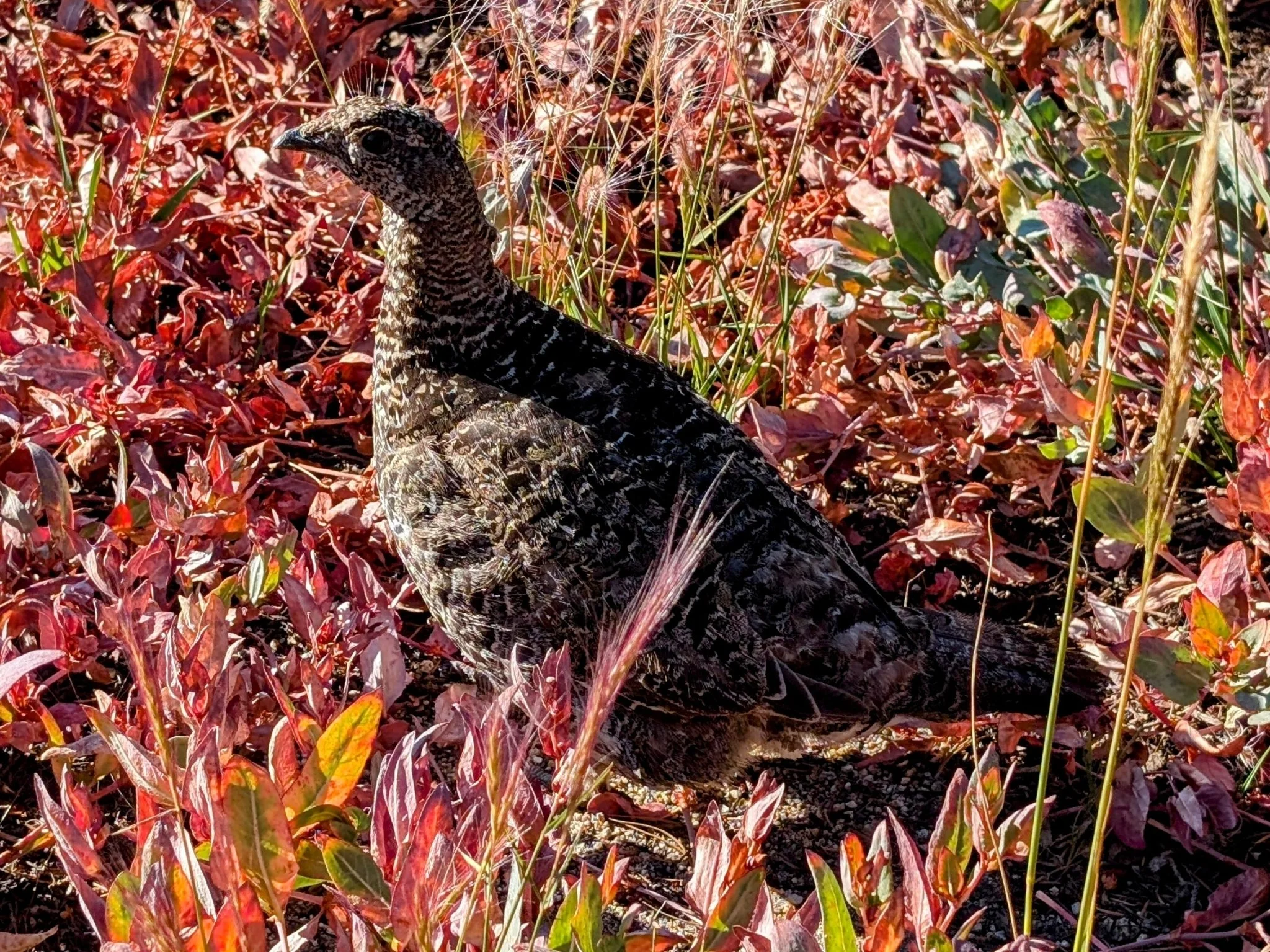
A sooty grouse in early-September ground cover in Placer County. Photo: James Fowler / CC BY 4.0 — source
2026–27 Season at a Glance
Dates: Sept. 12–Oct. 12 (the general season closes Monday, Oct. 12).
Daily bag: two grouse, all of one species or mixed. Possession is triple the daily bag.
Where it's open: only in these counties — Alpine, Amador, Butte, Calaveras, Del Norte, El Dorado, Fresno, Glenn, Humboldt, Inyo, Lake, Lassen, Madera, Mariposa, Mendocino, Modoc, Mono, Nevada, Placer, Plumas, Shasta, Sierra, Siskiyou, Tehama, Trinity, Tulare, Tuolumne, and Yuba. Every other county is closed to grouse.
Shooting hours: one-half hour before sunrise to sunset.
Paperwork: a California hunting license and the upland game bird validation (not required on a junior license).
Shot: nonlead only, statewide.
Sage-grouse: permit-only, and CDFW adopted zero permits in all four hunt zones for 2026–27. There is no sage-grouse season this year.
Checked against CDFW's 2026–27 seasons and limits and its grouse zone map on Oct. 7, 2026. Archery opens earlier; the CDFW upland game bird page is the authority. Forest fires and closures change access every fall, so check the national forest's alerts before you drive.
Know the Birds
Sooty grouse. The third-largest grouse in North America and the one most California hunters mean by "grouse" (CDFW still lists it as sooty, or blue, grouse). Males are a steely gray-blue with an orange comb over the eye; hens are mottled brown, buff, and white. In spring, males hoot from high in conifers — a deep, rhythmic call that carries but is hard to pin down. They eat needles, buds, berries, and insects, and early in the morning they often walk roads and trails picking up grit.
Ruffed grouse. Smaller, brown or gray, with a fan-shaped tail crossed by a dark band near the tip and dark ruffs on the sides of the neck. In California it lives only in the far northwest — Del Norte, Humboldt, Mendocino, Siskiyou, Trinity, Tehama, and Shasta counties — in wet forest with hardwoods along the creeks. A CDFW-funded monitoring project describes it as uncommon here and counts it by listening for the males' spring drumming.
Sooty grouse share their September edges with band-tailed pigeons, which feed on the same berries and flush gray out of the same shadows. Learn both flushes before you go: a grouse gets up with a whirr on round wings and drops back into cover or a tree; a band-tail climbs out over the timber on pointed wings and keeps going. In the band-tail North Zone counties, both are in season the same September week — and the pigeon also needs a HIP validation. Elsewhere in the Sierra, band-tails don't open until December.
Where They Live in California
Sooty grouse live in mid- to high-elevation conifer forest through the Sierra Nevada, the southern Cascades, the Klamath Mountains, and the North Coast Ranges: from the Klamath and Shasta-Trinity national forests south through the Lassen, Plumas, Tahoe, Eldorado, Stanislaus, Sierra, and Sequoia, plus the Mendocino in the Coast Range and the Inyo and Humboldt-Toiyabe on the east side of the crest. Our spring scouting piece puts the hooting males on the upper third of north- and east-facing slopes, roughly 4,000 to 6,500 feet in Northern California, and our September field report reads the fall cover as Jeffrey pine against aspen, with seeps, meadow edges, and berries close by.
The national parks in sooty grouse country — Yosemite, Sequoia and Kings Canyon, and Lassen Volcanic — are closed to hunting; our public land designations guide covers what is open around them.
How They're Hunted
California grouse hunting is mostly a walking game in September heat at elevation. What the hunters we've read describe:
Scout by ear in spring, hunt the same ground in fall. Males use the same display areas year after year, so a May hooting record is a strong lead for September.
Hunt the edges where forest types meet. Openings, meadow margins, the seam between conifer and brush or aspen, especially near water and ripening berries.
Plan the dog for altitude and heat. Steep ground, thin air, and a warm September afternoon add up fast; carry more water for the dog than seems necessary.
Hunting pressure on grouse is light because the birds are hard to find, not because they're everywhere. A day of walking without a flush is a normal grouse day in California.
Start Here
Hunting the Overlap: Sooty Grouse, Band-Tails, and Quail in the High Sierra in September. Our September field report: the cover, and three species sharing one mountain.
Sooty Grouse Spring Scouting in NorCal: Hooting, Habitat, and a Plan for Fall. How to find the birds in May so you know where to walk in September.
More for Grouse Country
California Wildfire Burn Scars and Upland Bird Habitat: A 2026 Planning Map
The Hill You Don't Climb: Off-Road Driving Skills for California Hunting Access
How to Scout Public Land for Upland Birds Without Leaving Your Couch
CDFW picked the sooty grouse for this year's upland game bird stamp art contest, and the winner goes on the state's next stamp. Entries open Nov. 2 and close Dec. 4.
Further reading: Cornell's species accounts for sooty grouse and ruffed grouse.
Other California Upland Birds
Doves · Quail · Pheasant · Chukar · Band-tailed pigeon · White-tailed ptarmigan · Wilson's snipe · All species
One email each Sunday: what opened, what we published, and what we're working on. Subscribe to the weekly digest.
Photo credit: sooty grouse, Placer County — James Fowler / CC BY 4.0 — source