
The Hill You Don't Climb: Off-Road Driving Skills for California Hunting Access
Source: Matt and Peter photographs
There is a turnaround every California upland hunter knows. You are four miles up a Bureau of Land Management (BLM) two-track off Knoxville-Berryessa Road, the ruts have gone from annoying to load-bearing, oak woodland is closing in on both mirrors, and you have no idea whether the next two hundred yards will go. So you swing the truck around, and the country you wanted is a ridge past anything you can walk to. What stopped you was not the truck. It was that off-road driving skills for California hunting access are the one piece of the hunt plan nobody ever taught us.
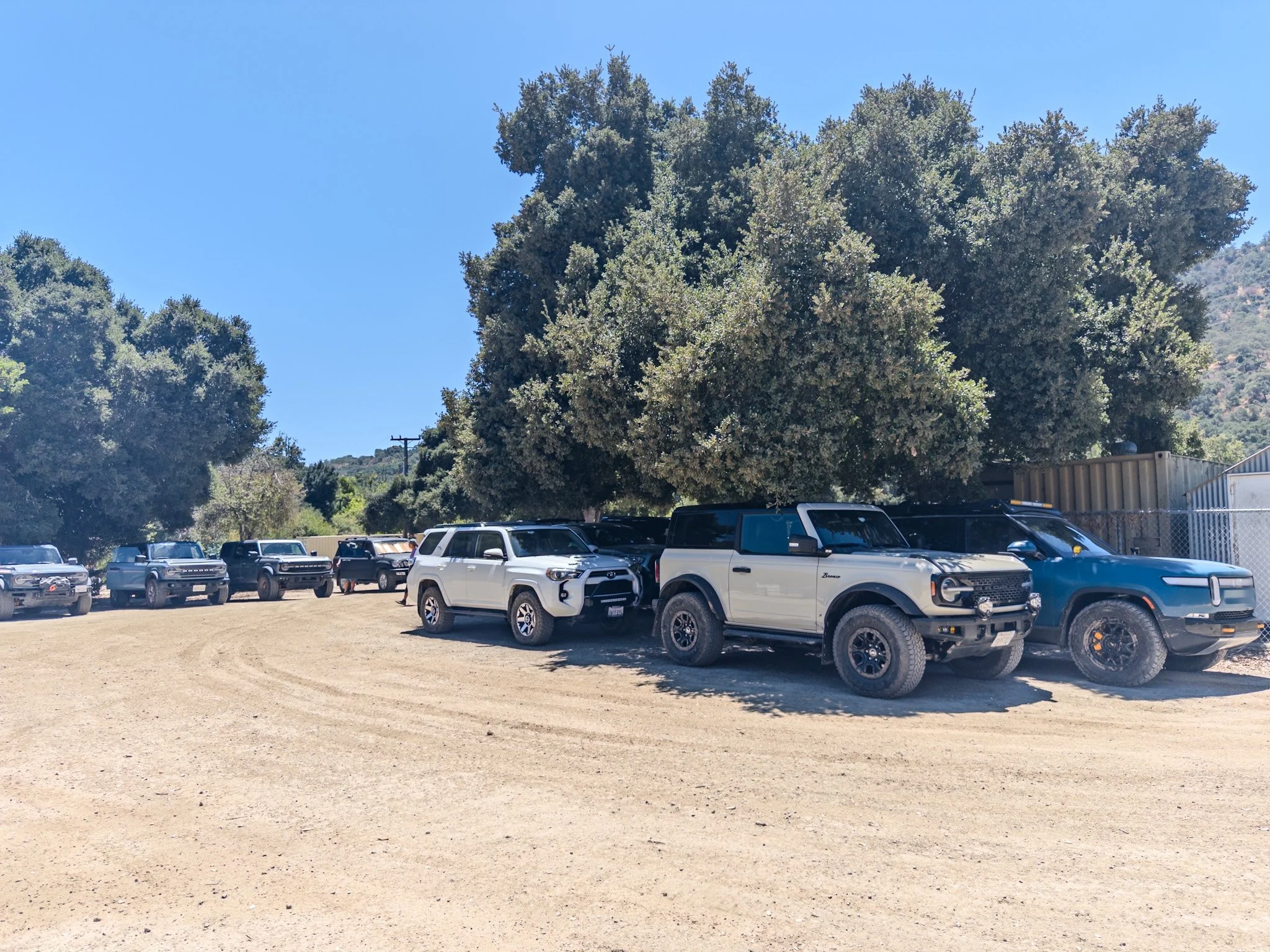
So we went and got taught. The one-day basic course last year and the one-day intermediate this summer, both run by The Driving Company at Hollister Hills State Vehicular Recreation Area, an hour south of San Jose — on the theory that the birds we want sit at the end of a road that gets worse, and that Alan rides those roads in with us.
Why Off-Road Driving Skills Belong in a Hunting Plan
The park's Upper Ranch is 800 acres of sandy granitic hillside grown up in sage, pine, and sticky monkey flower — you learn to drive in chaparral that looks exactly like the country you are trying to reach. Nobody planned that. It is still why the skills transferred cleanly to the Knoxville and Cache Creek access runs.
One of You Walks Ahead
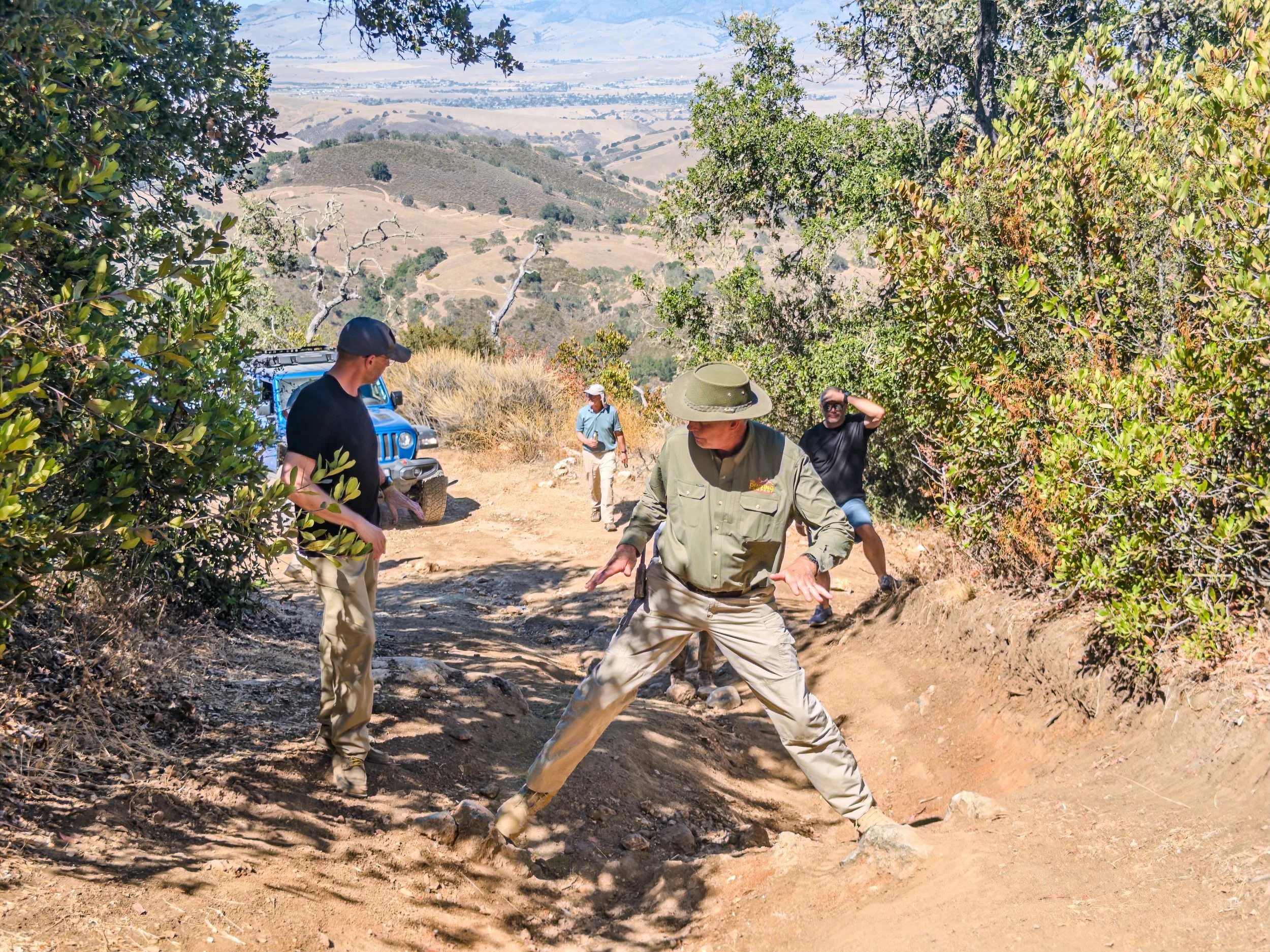
The highest-value thing in the basic curriculum costs nothing and requires no equipment: one person gets out and spots.
The spotter stands ahead of the vehicle and off to one side, where the driver can see them without craning, and directs tire placement — not the truck, the tires. The driver watches the spotter and nothing else, which takes practice, because every instinct says look at the rock. One spotter, never two.
Hunters have an advantage the average weekend wheeler doesn't: there are already two of us, and we already have boots on. The spot costs ninety seconds, and it buys the difference between putting a tire on the high side of a rut and discovering — from a seat where you can't see the front wheels at all — that you put it in the low side and the frame is now doing the work.
Hunting alone, the same skill works on a delay: walk it, set a rock on the line you picked, then drive to the marker.
Pro tip - settle your hand signals in the cab before the first obstacle, not standing in the dust over an idling engine.
When in Doubt, Get Out
The other free skill. If you can't see the whole of what you're about to drive, walk it first.
Walking an obstacle tells you three things a windshield never will: how deep the rut is under the grass and oak leaf litter, how off-camber the exit is, and what the surface is doing — a dry October two-track and the same track after an inch of rain are different roads with the same name. Cache Creek clay goes greasy fast, and it does it on the shaded north side of a ridge while the sunny side is still dust.
There's a dividend nobody mentions in class: walking the next hundred yards is scouting. You're reading cover on foot, at three miles an hour, in the exact draw you were about to drive past.
When to Back Down
The intermediate day is where the useful fear lives, and the hill abort is the piece we think about most.
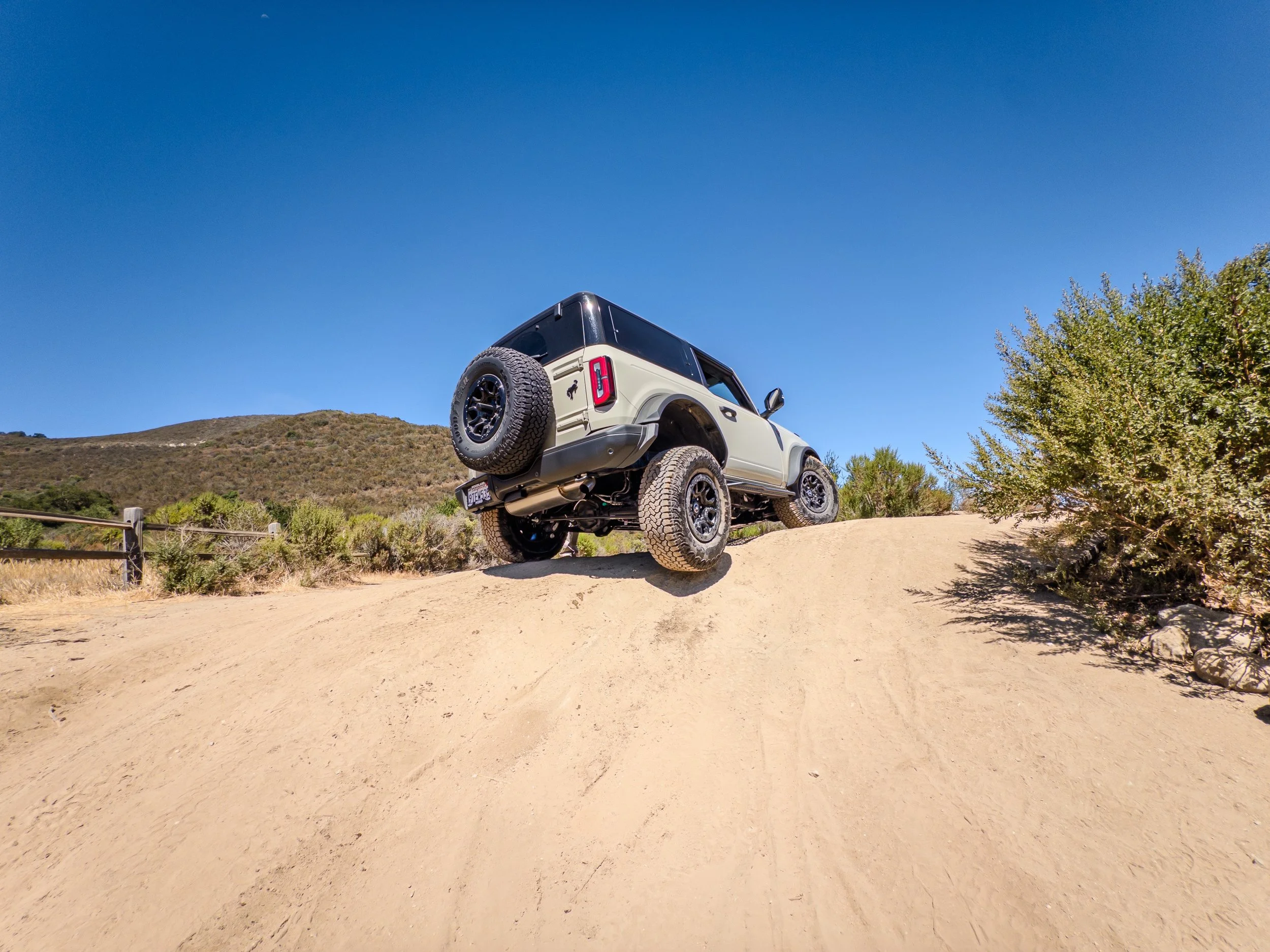
If a climb doesn't go — tires break loose, the nose gets light, the engine runs out of pull — the instinct is to steer for the nearest flat spot and turn around. That instinct is how vehicles end up on their roof. The answer is to stop, hold the brake, select reverse, and back down the exact line you came up: straight, both hands on the wheel, engine holding the speed rather than the brakes. You do not turn sideways on a steep grade. Not to reposition, not for a better look, not for a second. Practicing that where the worst case is embarrassment is worth the day by itself.
Which is the honest caveat about the whole exercise: two days did not make us good off-road drivers. It made us better judges of what we shouldn't attempt — a less flattering skill and a more useful one. We turn around more deliberately now, and earlier, and with less argument about it.
Two Feet, One Crawl
Left-foot braking felt like a party trick on the training ground and like a real tool the first time we used it on a rutted access road.
Left foot on the brake, right foot on the throttle, both at once. A little throttle keeps torque in the driveline and takes the slack out of it, so the truck crawls over a ledge instead of lurching off it; the left foot meters how fast that happens. On a loose climb it kills the moment where a spinning tire hooks up and the whole rig jumps.
It's unnatural for about twenty minutes and then it isn't. It turns a series of impacts into one continuous motion — and what absorbs those impacts when you don't is a U-joint, a driveshaft, or the dog.
Mechanical Sympathy
The idea tying the two days together: the rig is not what gets you to the birds. It's what gets you home from them, in the dark, forty miles from pavement.
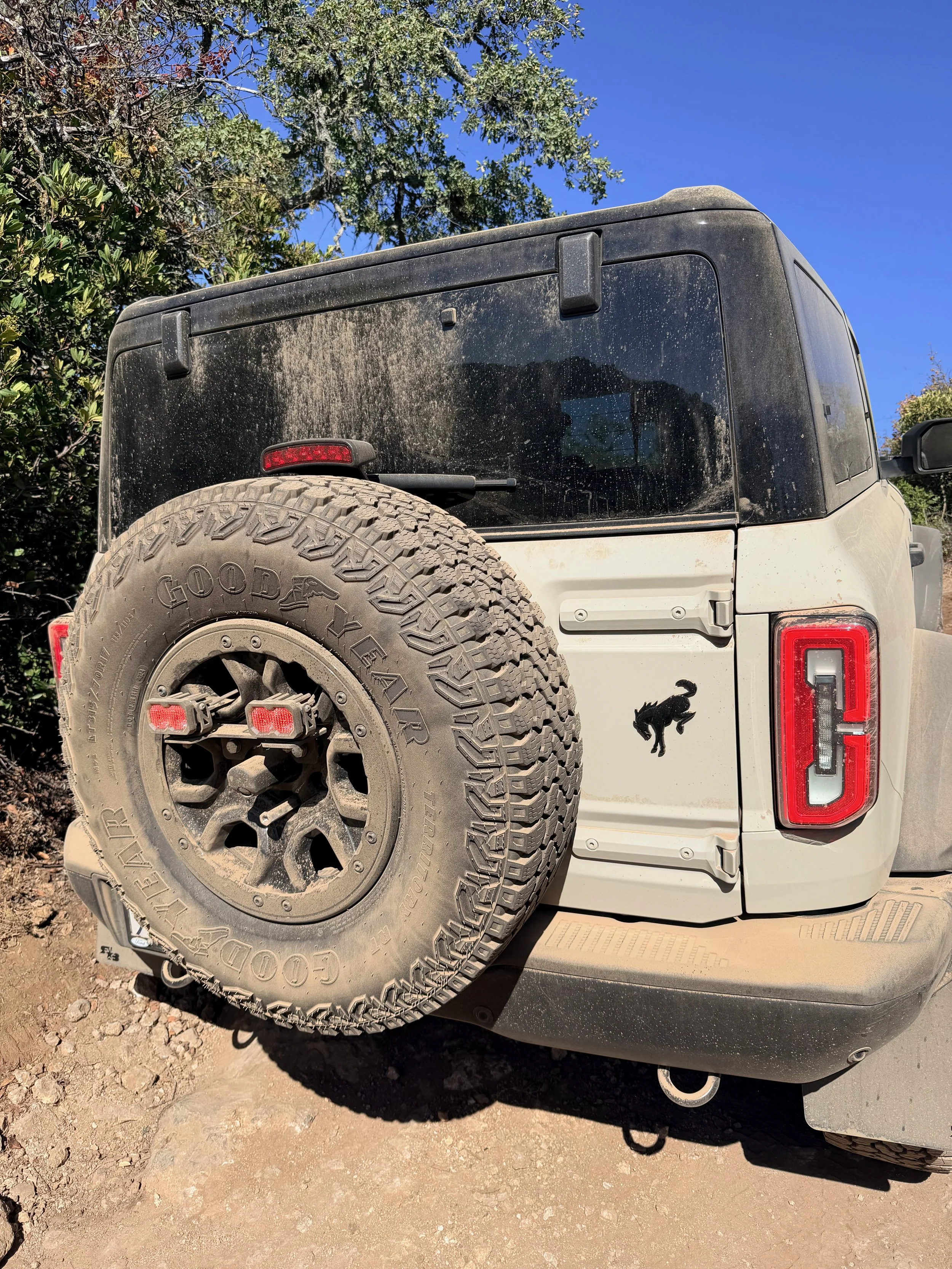
The truck is Matt's two-door Bronco Badlands with the Sasquatch package on the factory 35s, which makes the tradeoff concrete. The short wheelbase — a hair over a hundred inches, sixteen less than the four-door — is exactly what makes it good on a broken climb and exactly what makes it tight in back once Peter's crate and Alan's gear are aboard. The width doesn't shrink with the wheelbase: you're still wider than the ruts a Tacoma cut, still pinstriping paint on chamise the whole way in, and still driving something that will happily take you somewhere it can't get you out of alone.
None of which is the entry ticket. The two skills at the top of this piece work identically from a stock Tacoma, a 4Runner on street tires, or whatever high-clearance thing is already in your driveway — we describe the Bronco because it's what was under us, not because it's what you need. Airing down does more for traction than any of it and costs nothing but the time to air back up.
The rest is listening. Slow is smooth, and momentum is the last resort — solve an obstacle with speed and you're trading a driveline part you can't see for thirty seconds you didn't need. The dog belongs in that calculation too. Alan rides crated: a hard drop into a rut with a dog loose in the back is a vet bill that starts as a driving decision.
Skill Is Not a Permit
None of this changes where you're allowed to drive. Route legality is set by the managing agency's travel plan — Motor Vehicle Use Maps on national forest ground, the field office's designations on BLM — and a route not shown open is closed no matter how easily your truck could make it. Worth knowing what the designation under your tires actually is before the question comes up, and worth doing the e-scouting pass that sorts which green lines are roads and which are wishful.
That restraint is habitat work too. Ruts channel water, and a wet-season track cut above a seep pulls water off ground California quail broods depend on and hands it to cheatgrass and starthistle. The good draws in the Berryessa country are good partly because the roads there stop where they stop.
The best thing two days of instruction gave us was a shorter list of places we're willing to drive and a longer list we're willing to walk into. That isn't what we paid for. It's what we'd tell you to go get.
Basic is the prerequisite for the rest, and classes fill with waiting lists. We paid for both ourselves and The Driving Company had no involvement in this piece. Winching and recovery is next on the list — 2027, and a report will follow.
Matt Gehrmann grew up hunting the Central Valley for pheasant, quail, and dove, and is based in the Bay Area. Read more → · Subscribe to the weekly digest →
Peter Burnham grew up in Nevada hunting chukar in the Sierras and dove in the valleys and hunts behind Alan (a three-year-old English cocker). Read more → · Subscribe to the weekly digest →