
German Wirehaired Pointer
Deutsch Drahthaar: a versatile German pointing dog, 22 to 26 inches at the shoulder, in a wire coat built for rough cover and cold water.
The wirehair is the shorthair's rough-coated cousin. German sportsmen developed it in the late 1800s for the same do-everything job and gave it a weather-resistant wire coat for punishing cover. It was fifth in Project Upland's 2026 survey, at 8 percent. Its parent club describes "a close-working, easily trained gun dog" for people hunting on foot, which fits a lot of California. The coat that shrugs off cold water is a harder sell in September heat. Neither of us runs one, so this page leans on the breed club, the German testing tradition, and the writers who do.
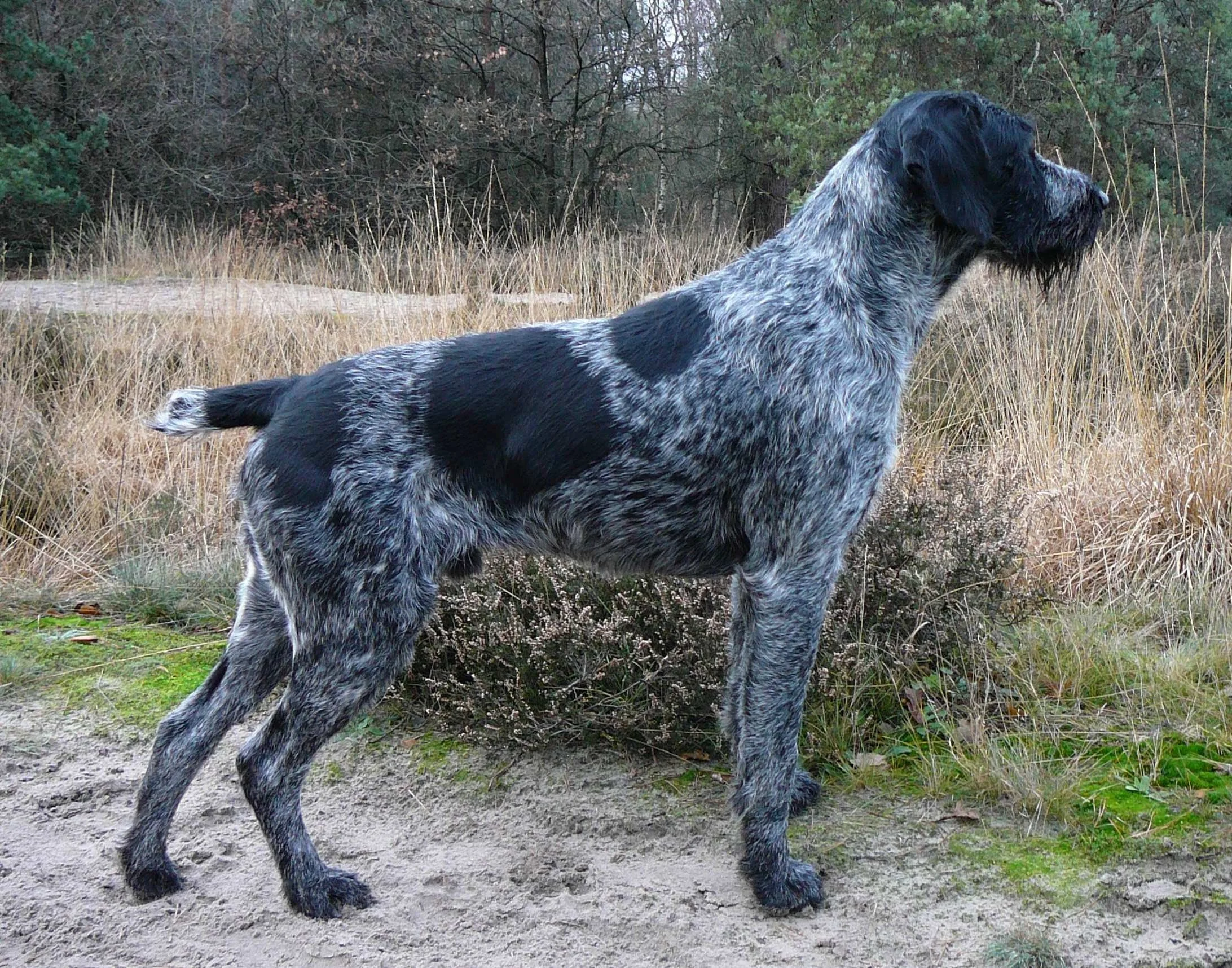
A black-roan German wirehaired pointer in winter cover. Photo: ad bekkers / CC BY-SA 3.0 — source

The Wirehair at a Glance
Type: versatile pointing dog.
Size: males 24 to 26 inches at the shoulder; bitches smaller, "but not under 22 inches" (AKC standard, which sets no weight).
Coat: a wire outer coat, "weather resistant and, to some extent, water-repellent," over an undercoat the standard says is "so thin in summer as to be almost invisible." Beard and brows. The parent club says a good coat "will shed most dirt and debris."
Range: close. The parent club calls it "a close-working, easily trained gun dog," bred to work with "one person or a small party of people hunting on foot."
Where they're tested: AKC field trials and hunt tests, NAVHDA, and, for Drahthaars, the German JGHV tests through the North American group of the German breed club, the VDD.
Health clearances the parent club lists: hips (OFA or PennHIP), elbows, thyroid, an eye exam, and a cardiac exam; a DNA test for von Willebrand disease is optional.
Parent club: German Wirehaired Pointer Club of America
Checked against the AKC breed standard and the German Wirehaired Pointer Club of America on Oct. 15, 2026.
How They Hunt
A wirehair hunts like a shorthair at closer range and in rougher cover: it points, retrieves to hand, tracks a cripple, and fetches from the water. The AKC's guide to the pointing breeds says that when hunting, the wirehair "will always check back to see where the hunter is." Field-trial lines exist, and Gun Dog notes that some "may even resemble wide-running English pointers," but the breed's center of gravity is the hunter on foot.
Every German wirehaired pointer descends from the Deutsch Drahthaar, and the international kennel federation, the FCI, still treats them as one breed. The difference is the breeding rules. A Drahthaar bred under the VDD, the German breed club founded in 1902, has to pass performance tests before it can be bred. The AKC, the UKC, and NAVHDA impose no such rule. The VDD's North American group issues FCI pedigrees, and it holds that the American wirehair has become a different dog. That argument is theirs to have. For a California buyer, the practical point is that a VDD litter comes with a test record on both parents.
In California Country
Heat. This is the breed's California question. Outdoor Life's breed roundup calls the wirehair's use in heat "a drawback" and places it at its best in cold, wet conditions. The undercoat thins in summer by design, but the dog still carries more coat than a shorthair onto a September dove field. Heat Safety for Bird Dogs: California Off-Season Conditioning as Temps Rise and our September heat piece are where we'd start.
Brush and water. The wire coat should earn its keep in Coast Range chaparral and around Sacramento Valley sloughs. The standard asks for a coat "long enough to protect against the punishment of rough cover." The beard, its own club admits, "can carry an amazing amount of dirt, food and water," so in foxtail season it is one more place to check. Foxtail Season for California Bird Dogs: A Handler's Prevention and First-Aid Plan covers what handlers and vets watch for.
Choosing One in California
AKC or VDD. The first question is which system a litter comes from. A VDD litter's parents have passed JGHV tests. An AKC litter's parents may or may not have hunt-test or NAVHDA titles, which a breeder can show you.
Clearances. Hips, elbows, thyroid, eyes, and cardiac, per the parent club. Results are public in the OFA database.
Where to see them. The VDD-GNA's Wild West Chapter held spring VJP tests for young Drahthaars in Susanville in 2025 and 2026. NAVHDA's California chapters, on its chapter map, test wirehairs alongside every other versatile breed.
What We've Written on Dogs
Choosing a dog
Keeping one going in California
Foxtail Season for California Bird Dogs: A Handler's Prevention and First-Aid Plan
Heat Safety for Bird Dogs: California Off-Season Conditioning as Temps Rise
Heat, Shade, and Water Strategy: Don't Cook Your Dog on Sept 1
The Four Weeks That Decide October: Quail Prep While Dove Is Still Open
In the field with Alan
What I Carry for Alan: A California Bird-Dog Kit That Actually Works
Hunting the Overlap: Sooty Grouse, Band-Tails, and Quail in the High Sierra in September
From a Dove Field Back to Quail: Peter Burnham on The Upland Social
More in our Dogs archive and the dog section of Hunting Resources.
Other Breeds
German shorthaired pointer · Brittany · English setter · Pointer · Labrador retriever · English springer spaniel · English cocker spaniel · All breeds
One email each Sunday: what opened, what we published, and what we're working on. Subscribe to the weekly digest.
Photo credit: German wirehaired pointer — ad bekkers / CC BY-SA 3.0 — source