
English Cocker Spaniel
The smallest flushing spaniel here, 26 to 34 pounds by the AKC standard, built to get into low, tight cover, flush the bird, and bring it back.
This is the breed we know firsthand. Peter hunts behind Alan, a three-year-old English cocker, and Alan's wild-bird record runs to California quail, chukar, and dove, plus a band-tailed pigeon he flushed on a High Sierra trip in September 2026. He started with urban gundog training in Golden Gate Park. He also carries the breed's California warning label: a grass seed in the ribcage cost him two surgeries and Peter a $10,000 vet bill, which is why he now works in a protective vest. Nationally the English cocker is a niche dog, at 3.2 percent in Project Upland's 2026 survey. In California's brush it makes a strong case.
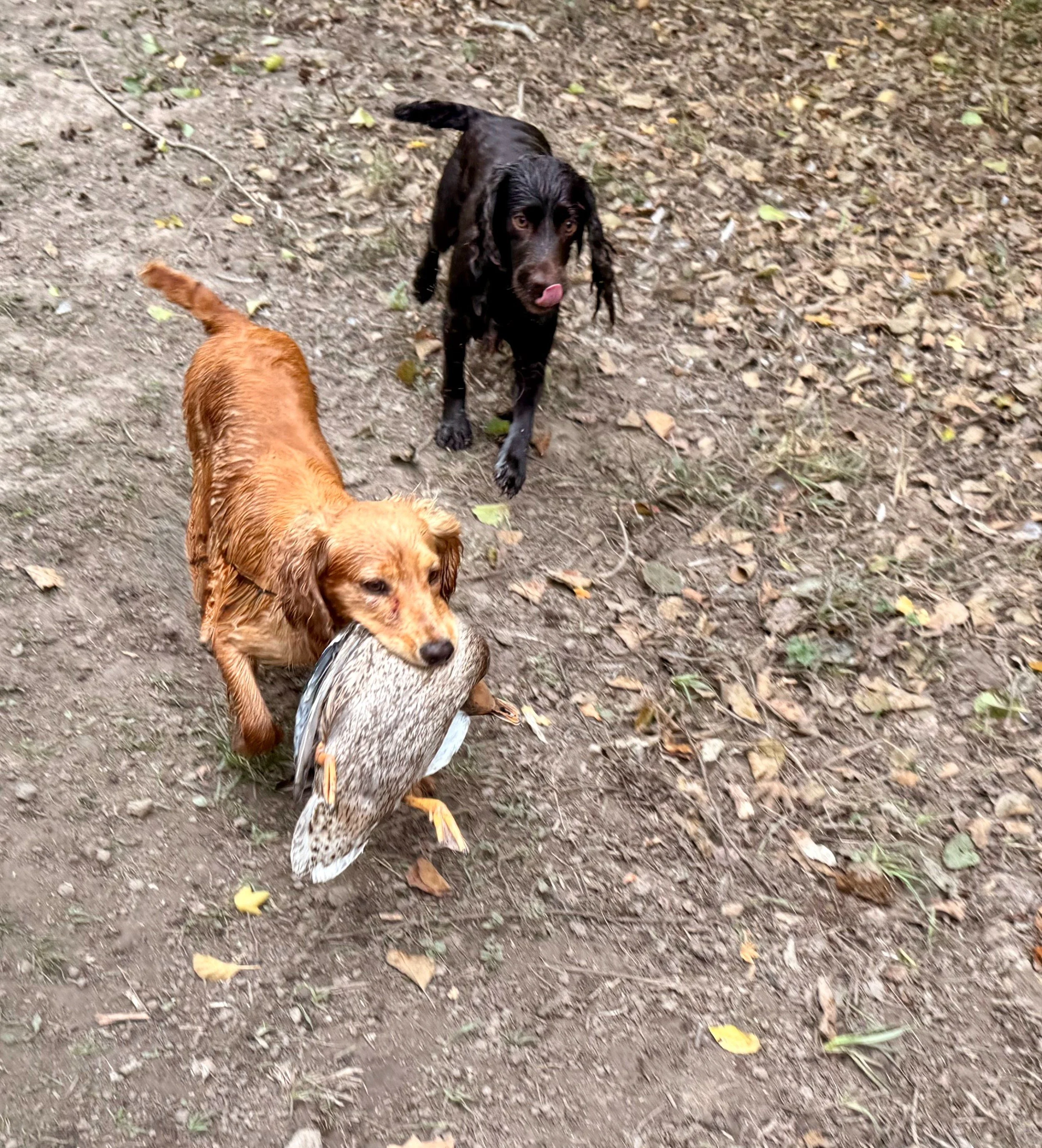
A working-line English cocker on a retrieve. Photo: Xavier Laurent Lévy / CC BY-SA 4.0 — source

The English Cocker at a Glance
Type: flushing spaniel.
Size: males 16 to 17 inches at the shoulder and 28 to 34 pounds; females 15 to 16 inches and 26 to 32 pounds (AKC standard). Working cockers often run smaller; Gun Dog puts the contemporary English cocker at 20 to 30 pounds.
Coat: silky, flat or slightly wavy, "well-feathered, but not so profusely as to interfere with field work," per the standard. Working lines carry "finer coats and far less feathering," per the UK's Cocker Spaniel Club.
Range: within gun range, which the AKC's hunt-test guidelines put at "about 30 to 40 yards."
Where they're tested: AKC cocker field trials, where English and American cockers run together; AKC spaniel hunt tests; and the parent club's Working Dog and Working Dog Excellent certificates.
Health clearances the parent club lists: hips, patellas, and a DNA test for PRA (prcd), plus at least two electives from a list that includes a familial nephropathy (FN) DNA test, an eye exam, a BAER hearing test, thyroid, and DNA tests for acral mutilation syndrome (AMS) and exercise-induced collapse (EIC).
Parent club: English Cocker Spaniel Club of America
Checked against the AKC breed standard and the English Cocker Spaniel Club of America's health pages on Oct. 15, 2026.
How They Hunt
A cocker hunts like a springer in a smaller package: quartering in front of the gun, nose down, then a flush that Gun Dog's spaniel writer calls "high" and "dynamic" on quail. The same writer credits the cocker's size for its edge in "low, tight, and prickly brush," which describes a lot of California quail cover. The parent club calls it "an outstanding rough shooting dog," meaning a dog for a walking hunter who takes what gets up.
Two notes on names. The English cocker is not the American cocker spaniel, which the AKC describes as smaller and rounder-headed, and which the AKC's own trial history calls "a modern day, field-trial dinosaur." Within the English breed, the UK's Cocker Spaniel Club recognizes "two distinct strains," show and working. The working cocker is rangier, finer-coated, and lightly feathered.
In California Country
Brush. Alan found his first wild birds in the oak and chamise around Lake Berryessa. That is the kind of low, tight cover Gun Dog's writer describes. Our September report from the High Sierra shows him working a different kind of cover.
Foxtails. Spaniels draw grass seeds. A UK study of veterinary records found spaniel types 7.7 times more likely than retriever types to be seen for a grass-seed foreign body, and Alan's two surgeries are the California version of that number. Peter runs him in a Field Armor V2 vest, and Foxtail Season for California Bird Dogs: A Handler's Prevention and First-Aid Plan has the prevention plan.
Heat. A cocker hunts flat out, and September in California is hot. What Peter carries for Alan, including water, a collapsible bowl, and first aid, is in What I Carry for Alan: A California Bird-Dog Kit That Actually Works. Our heat, shade, and water piece is the September plan.
Choosing One in California
Working lines. For a hunting dog, the working strain is the one to look at. The show strain is a different-looking dog with a heavier coat.
Clearances, and two to ask about. Hips, patellas, and PRA (prcd) are the parent club's required tests. Its health and rescue site adds that acral mutilation syndrome (AMS) and exercise-induced collapse (EIC) are "primarily seen in Field/Working Cockers," and it urges field breeders and owners to use the AMS DNA test. For a working-line pup, both results belong in the file. Our puppy piece also flags familial nephropathy, which is on the club's elective list. Results are public in the OFA database.
Where to see them. Cocker field trials still run in California. The 2026 cocker field-trial calendar lists them near Hesperia, with the Southern California Sporting Spaniel Club, and near Orland, with the Stockton English Springer Spaniel Club.
What We've Written on Dogs
In the field with Alan
What I Carry for Alan: A California Bird-Dog Kit That Actually Works
Hunting the Overlap: Sooty Grouse, Band-Tails, and Quail in the High Sierra in September
From a Dove Field Back to Quail: Peter Burnham on The Upland Social
Choosing a dog
Keeping one going in California
Foxtail Season for California Bird Dogs: A Handler's Prevention and First-Aid Plan
Heat Safety for Bird Dogs: California Off-Season Conditioning as Temps Rise
Heat, Shade, and Water Strategy: Don't Cook Your Dog on Sept 1
The Four Weeks That Decide October: Quail Prep While Dove Is Still Open
More in our Dogs archive and the dog section of Hunting Resources.
Other Breeds
German shorthaired pointer · Brittany · English setter · Pointer · German wirehaired pointer · Labrador retriever · English springer spaniel · All breeds
One email each Sunday: what opened, what we published, and what we're working on. Subscribe to the weekly digest.
Photo credit: English cocker spaniel — Xavier Laurent Lévy / CC BY-SA 4.0 — source