
Foxtail Season for California Bird Dogs: A Handler's Prevention and First-Aid Plan
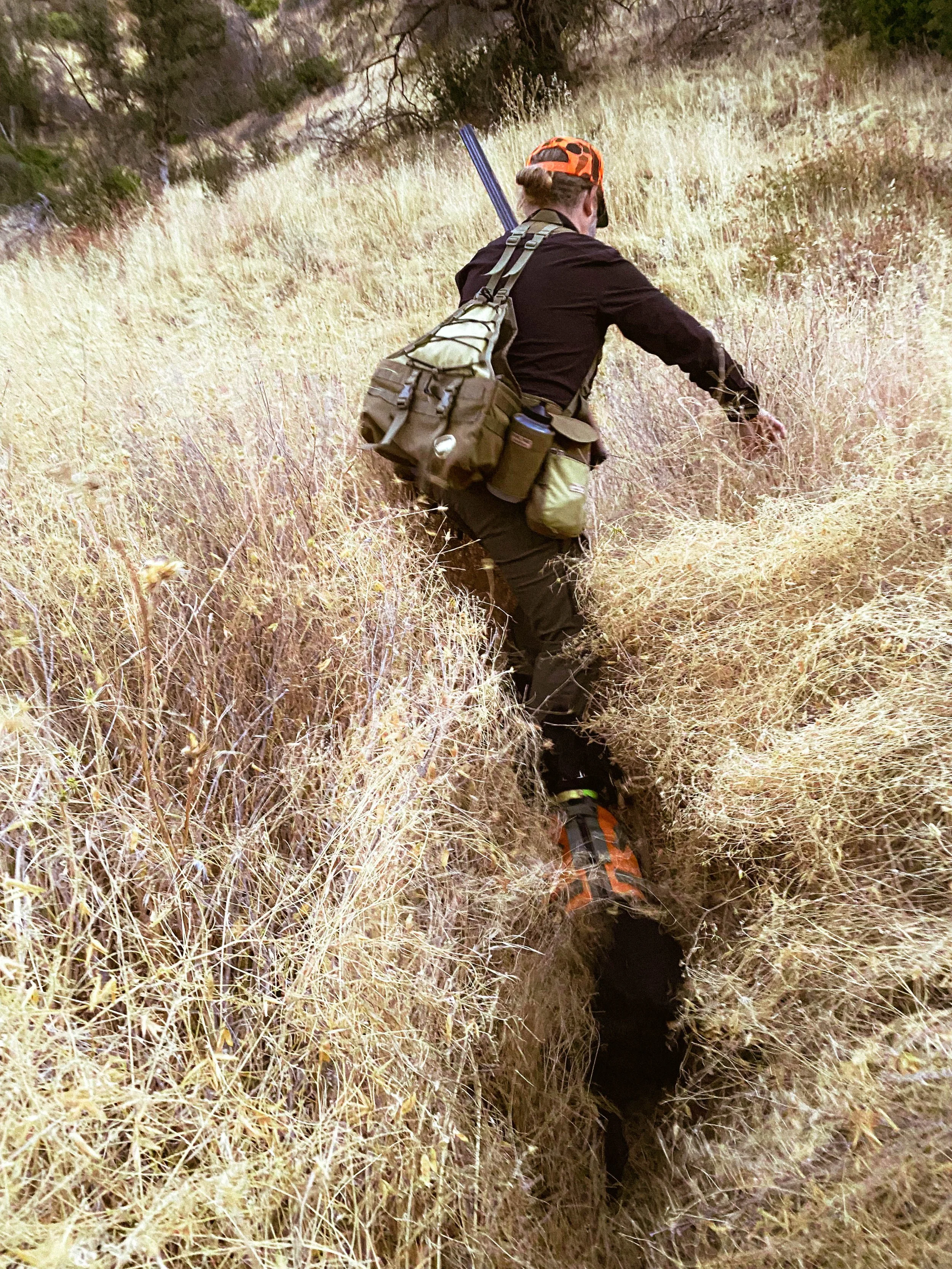
Peter and Alan busting brush and looking for quail - photo by Matt Gehrmann
The first summer I ran Alan, a grass seed worked its way into his side during a routine training session at the Presidio in San Francisco — one of the few solid weekday training spots in the city for a handful of us birddog trainers— somewhere along his ribcage I never even saw go in. No limp, no obvious puncture, no pain, nothing that would've made me stop and check. Within a couple of days it had turned into an abscess the size of a grapefruit, which is a genuinely terrifying thing to find on a 32-pound dog. His temperature spiked and he went quiet in a way that scared me more than the swelling did.
The vet opened him up and flushed the abscess that day and found nothing — no burr, no foreign body, no obvious point of entry. We took Alan home to watch him, and for three weeks on antibiotics he was fine. Then we took him off them, and within days he took a real turn for the worse — fever back, struggling to get up on his own. An ultrasound finally found it: a single grass awn, buried against a rib the whole time. The vet removed it, and a few days later Alan was getting back to normal.
Almost $10,000 later (thank God for pet insurance), I've learned the most expensive lesson of my hunting life: do the most thorough tailgate check you've ever done, every single time — because a dog that seems fine can be carrying something you never saw go in.
Foxtail season is the single biggest off-season hazard for California bird dogs. It runs from late May, when the annual grasses cure gold, through the first soaking rains in October or November. The cover that holds quail in October is the same cover that's loaded with awns in July. This is the prevention-and-first-aid plan I run with Alan.
What a Foxtail Actually Is, and Why It Moves
The "foxtail" most California handlers mean is the seed head of an invasive annual grass — Hordeum murinum(foxtail barley), Bromus diandrus (ripgut brome), or Avena fatua (wild oat) — that dries and shatters in May and June. Each shattered awn is a hard, sharp seed with backward-pointing barbs along its shaft. The barbs only let the awn travel one direction: forward, deeper into whatever it's caught in. The barbs work like a check valve. A dog's own motion — running, panting, licking — drives the awn inward.
The four entry points are the four soft accesses a running dog presents to grass at boot height: between the toes (most common, and easiest to catch early), into the ear canal (second most common, and the one that scares vets the most because it can rupture an eardrum), into the nostrils (third — usually inhaled at full sprint through standing grass), and into the eyes (fourth, rarer, and an immediate vet visit). Once an awn has moved past the surface, it does not back out. Vets describe pulling awns out of legs after they've migrated four or five inches through subcutaneous tissue from a paw entry, and awns from a nostril have reached sinuses and even the brain in extreme cases.
The piece I want every California dog handler to internalize is the asymmetry. The window to catch a foxtail is measured in hours, not days. A surface awn that you find in an after-run inspection comes out with tweezers in thirty seconds. The same awn missed for forty-eight hours is a sedation visit and a week of crate rest. The same awn missed for a week is an open question.
The Daily Routine
Three years with Alan has stripped the routine down to four pieces. None of them is clever; all of them are habits I do not skip.
Before the run. I look at the cover. If it's cured grass at boot height — gold rather than green, seed heads visible — Alan stays in the truck and we go somewhere else, or we run pre-dawn when the dew is still down on the awns and weighs them. I will not punch a flushing dog through dry ripgut for the sake of a workout. The 4 a.m. headlamp run on a dirt road beats the 9 a.m. run through cured grass every time. Most of June and July, we run watered ground — irrigated park edges, mowed firebreaks, the Knoxville canyon bottoms that hold cottonwood and willow shade and stay green — and we do the cover work in October when the awns are washed down by the first storms.
The trim. Alan's a cocker, and the breed's coat is built to collect awns. I’d love to trim him short, but I compromise with my partner who thinks his fuzzy legs and ears are his best qualities. So I use Cowboy Magic which lets 90% of the burs pull through with a pass of the comb. It is a lifesaver!
The after-run inspection. Tailgate, headlamp on if the light is gone, and seven minutes start to finish. Spread every toe and look between every pair. Lift each ear flap and look inside, then run a fingertip around the canal opening. Look at the flews, the eye corners, the armpits, the groin, the base of the tail. Run a hand against the grain of the coat from neck to tail. If the dog sneezes hard or shakes his head during the inspection, that's information — pay attention. I keep a fine-point tweezers in the first-aid kit Matt and I both pack for our bird-dog field first-aid setup (the same kit, different dog), and any surface awn I find comes out right there.
The watch. Twenty-four to seventy-two hours after a run through any cover that might have held awns, I'm paying attention to four signals. Persistent licking or chewing at one foot. A swollen, warm, or weeping toe-web. A head tilt or persistent shaking. Violent sneezing that doesn't quit in five minutes. Any one of those is a same-day vet call. There's no "let's see how he is tomorrow" with a suspected migrated awn. The cost of being early is a phone consultation; the cost of being late is surgery.
What I Carry
Nothing exotic. A pair of fine-point tweezers (the cheap drugstore kind work fine — sharper is better for surface awns under coat). A bottle of saline eye wash for a quick eye flush if Alan paws at his face after a run. A few squares of vet wrap for a paw that needs a temporary bandage on the drive home. The first-aid kit is the same kit I carry in October — see What I Carry for Alan: A California Bird-Dog Kit That Actually Works for the broader setup. Summer adds nothing to the kit except a slightly bigger water bottle, a portable bowl, and a habit.
The Two Things This Plan Doesn't Tell You
Two named caveats, because no prevention plan is the whole answer.
It doesn't prevent every awn. I caught a deep ear awn on Alan in August 2024 — he ran a ditch line at Quail Point that was loaded — and the after-run inspection didn't show me anything because the awn had already moved past the canal opening. Two days later he was tilting his head and pawing at it. The vet pulled it under sedation. He was fine. The point is the plan reduces incidence; it does not zero it. Knowing the warning signs and acting on them inside seventy-two hours is what saves the eardrum.
It doesn't substitute for terrain choice. No after-run inspection makes it acceptable to run a dog through chest-high cured ripgut for an hour in July. The plan starts with not running the dog there. If your only summer training ground is foxtail country, the answer is to find different ground for the off-season — irrigated park, ridge-top dirt road, the wet edges of a reservoir — and save the upland cover for the fall after the rain has knocked the awns down.
The Conservation Piece Underneath
The foxtail problem is, at its root, a non-native grass problem. Hordeum murinum, Bromus diandrus, and their cousins are Mediterranean annuals that have replaced California's native perennial bunchgrasses across most of the state's rangeland. The native perennials — purple needlegrass, Idaho fescue, blue wildrye — don't shatter into barbed awns the way the invaders do; they hold their seed differently and they hold structure year-round, which is exactly the cover quail broods need in June and July. The hillside that's safer for your dog is also the hillside that holds more birds in October. The Hands-On Habitat Month volunteer hours that go into native-grass seeding and prescribed-fire support are doing two things at once. See How California Hunters Show Up for the Uplands in May for where to put a workday next spring.
— Peter
Peter Burnham grew up in rural Nevada hunting doves and ducks and hunts behind Alan (a ridiculous English Cocker). Read more → · Subscribe to the weekly digest →
