
English Setter
One of the oldest gundog breeds: a feathered pointing dog of about 24 to 25 inches, stylish on point and high-maintenance in foxtail country.
The English setter topped Project Upland's 2026 survey of North American bird hunters at 18 percent, after three years behind the German shorthair. Its parent club traces the breed's history to the 14th century. Setters run in the West, too: Gun Dog's profile of the breed quotes an Arizona hunter who runs hers on desert quail. California just asks more of the coat than most places, with foxtails, burrs, and September heat. Neither of us runs a setter, so this page leans on the breed club and on the people who do.
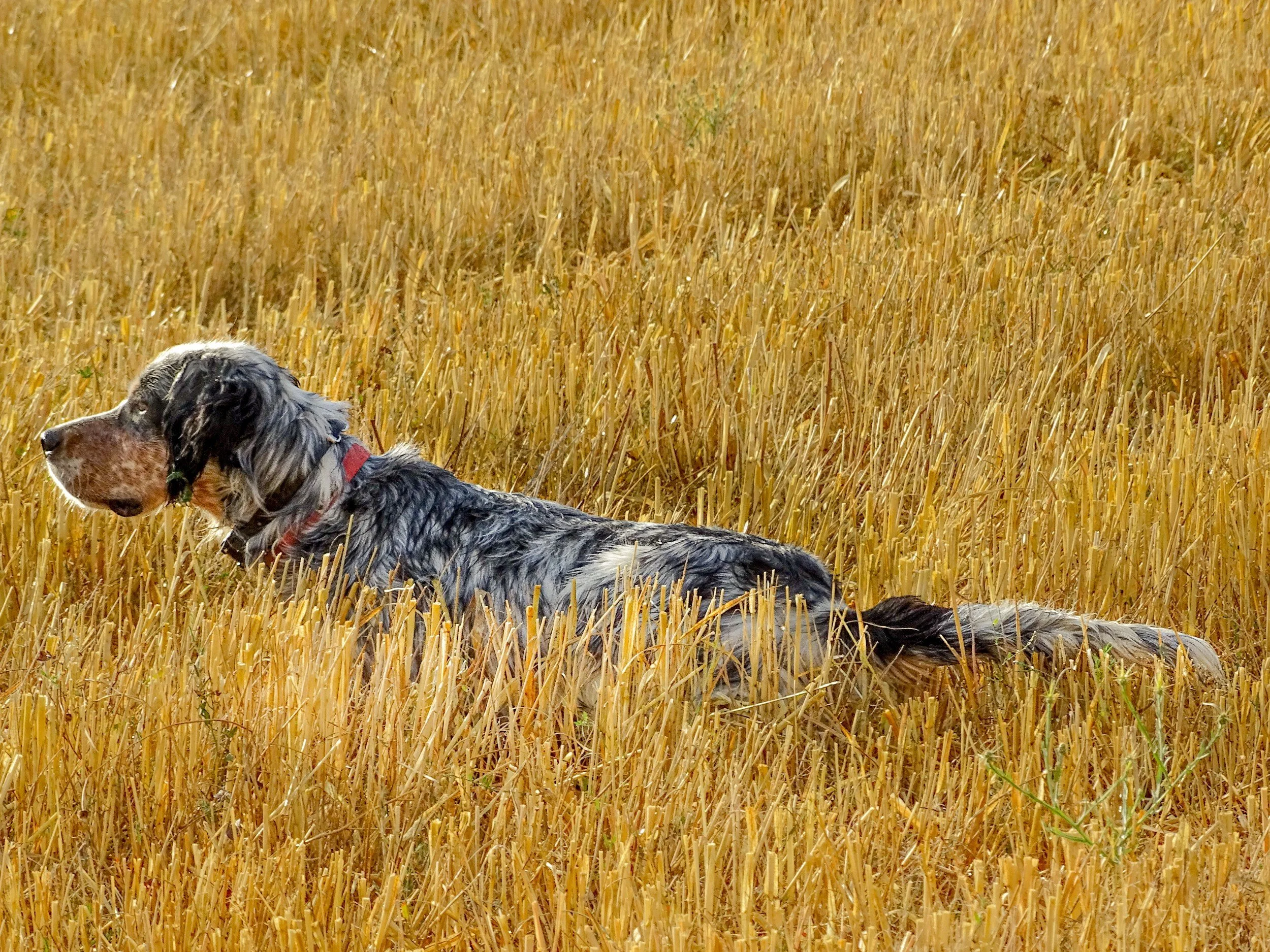
An English setter on point in summer stubble. Photo: Malvasanesteban / CC BY-SA 4.0 — source

The English Setter at a Glance
Type: pointing dog. NAVHDA lists it among its recognized breeds.
Size: about 25 inches at the shoulder for dogs and about 24 for bitches; the AKC standard sets no weight. The English Setter Association of America says field-bred setters are "a little smaller and carry less coat" than setters from show stock.
Coat: flat and feathered. The standard wants feathering that never hides the dog's lines or affects its "function as a sporting dog," and the parent club warns that a neglected coat "forms mats and knots."
Range: wide by instinct. The parent club describes a dog bred "to range far from the hunter, making independent decisions in the field," with range set by the cover it is working.
Where they're tested: AKC field trials and hunt tests; the parent club's own hunting tests; NAVHDA; and American Field trials, where field setters are registered in the Field Dog Stud Book.
Health clearances the parent club lists: a BAER hearing test, hips and elbows, and thyroid.
Parent club: English Setter Association of America
Checked against the AKC breed standard and the English Setter Association of America on Oct. 15, 2026.
How They Hunt
Setters point with style, and a field-bred setter covers ground. The parent club is candid that the breed's instinct is to hunt out and decide for itself, and its hunting-test rules say range "is determined by the type of cover the dog is working."
"Llewellin" is the name you'll hear for field setters. The parent club's breed flier says it "is not a separate breed," just another name for a field-bred English setter. The Field Dog Stud Book does register a Llewellin bloodline separately, which is where the confusion comes from.
In California Country
Coat. This is the breed's California problem. "Setters and burrs are a bad combination," a trainer told Outdoor Life. The Arizona hunter in Gun Dog's profile says desert heat "is resolved by clipping their coats," and Project Upland notes that some hunters and field trialers shave their setters before a hot season. A field-bred setter carries less coat to begin with. In foxtail country, that coat is a daily inspection; Foxtail Season for California Bird Dogs: A Handler's Prevention and First-Aid Plan covers what handlers and vets watch for.
Feet. Gun Dog's Dave Carty notes that "even tough-footed dogs can't run for long in chukar country without foot problems." That holds for every breed, and it matters most for a dog that loves to cover ground.
Open country. Where you can see a dog at distance, on open chukar slopes or rolling grassland, a wide setter is a pleasure to watch. In Coast Range chamise the same dog is out of sight in seconds.
Choosing One in California
Field-bred or show-bred. The split matters more here than in most breeds. The parent club's own FAQ says field-bred setters are smaller, carry less coat, and range wider than show-bred dogs. In California's heat and foxtails, the lighter coat is the one to want.
Clearances. BAER, hips, elbows, and thyroid make up the parent club's CHIC list. Results are public in the OFA database.
Clubs. The parent club's regional club list includes four California clubs, but we couldn't find a 2025 or 2026 field event from any of them online. NAVHDA's California chapters, on its chapter map, and AKC pointing-breed hunt tests, which are open to every pointing breed, may be the easier place to see setters work.
What We've Written on Dogs
Choosing a dog
Keeping one going in California
Foxtail Season for California Bird Dogs: A Handler's Prevention and First-Aid Plan
Heat Safety for Bird Dogs: California Off-Season Conditioning as Temps Rise
Heat, Shade, and Water Strategy: Don't Cook Your Dog on Sept 1
The Four Weeks That Decide October: Quail Prep While Dove Is Still Open
In the field with Alan
What I Carry for Alan: A California Bird-Dog Kit That Actually Works
Hunting the Overlap: Sooty Grouse, Band-Tails, and Quail in the High Sierra in September
From a Dove Field Back to Quail: Peter Burnham on The Upland Social
More in our Dogs archive and the dog section of Hunting Resources.
Other Breeds
German shorthaired pointer · Brittany · Pointer · German wirehaired pointer · Labrador retriever · English springer spaniel · English cocker spaniel · All breeds
One email each Sunday: what opened, what we published, and what we're working on. Subscribe to the weekly digest.
Photo credit: English setter — Malvasanesteban / CC BY-SA 4.0 — source