
German Shorthaired Pointer
Deutsch Kurzhaar: a versatile pointing dog of 45 to 70 pounds in a short, hard coat, bred in Germany to hunt, point, and retrieve on land and water.
For three years running, the shorthair was the breed North American upland hunters most often told Project Upland they hunted behind. In the 2026 survey it finished a tenth of a point behind the English setter, 17.9 percent to 18. German breeders built it in the 19th century for a hunter on foot who wanted one dog for everything: find the bird, point it, and fetch it from the field or the water. That is still the pitch. Neither of us runs a shorthair, so this page leans on the breed club, the standard, and the trainers and writers we trust, and it says so where it matters.
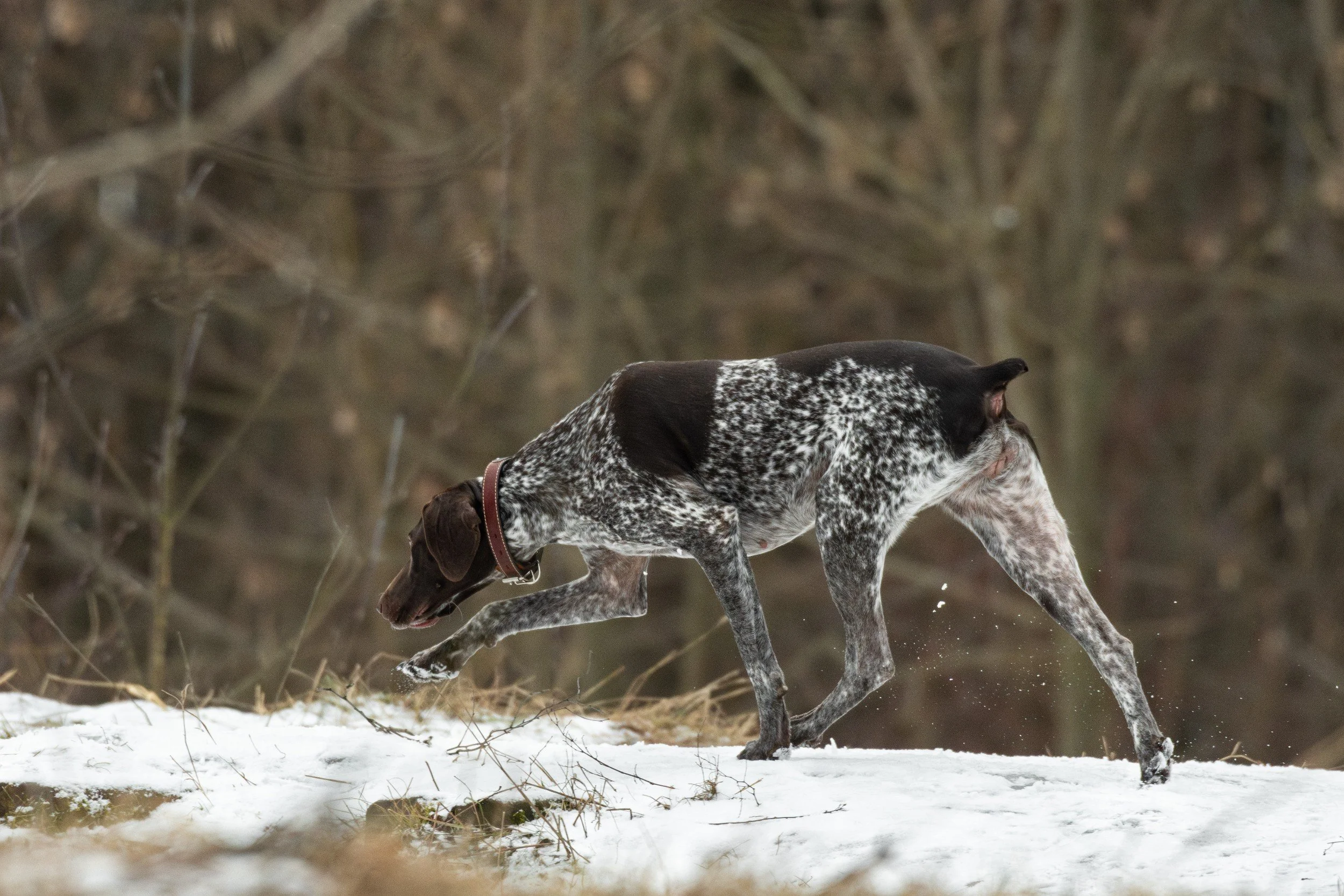
A German shorthaired pointer works a scent line in late-winter snow. Photo: M. S. Gorbunova / CC BY-SA 4.0 — source

The Shorthair at a Glance
Type: versatile pointing dog. The AKC standard calls it "a versatile hunter, an all-purpose gun dog capable of high performance in field and water."
Size: dogs 23 to 25 inches at the shoulder and 55 to 70 pounds; bitches 21 to 23 inches and 45 to 60 pounds (AKC standard).
Coat: short and thick, and in the standard's words it "feels tough to the hand." The parent club calls the coat easy care. It still sheds.
Range: the breed club doesn't set one, and it varies by line. Field-trial shorthairs are bred to run "fast and far in competition," in Gun Dog's phrase.
Where they're tested: AKC field trials and hunt tests; NAVHDA; American Field trials through the National German Shorthaired Pointer Association; and the German Kurzhaar system through the North American Deutsch Kurzhaar Club.
Health clearances the parent club lists: hips, elbows, an eye exam every year to age 6, a cardiac exam by a board-certified cardiologist at 24 months or older, and a DNA test for cone degeneration.
Parent club: German Shorthaired Pointer Club of America
Checked against the AKC breed standard and the German Shorthaired Pointer Club of America on Oct. 15, 2026. The club's health requirements page is the authority on clearances.
How They Hunt
A shorthair hunts ahead of the gun, locks up when it winds a bird, and holds until the hunter walks in. Every pointing breed does that. The versatile part is the rest of the job: retrieving to hand on land, swimming down a crippled bird, and tracking one that runs. NAVHDA's tests score exactly that list, and its chapter map shows six chapters in California, from the north state to San Diego.
Range is the variable. Field-trial lines are bred to cover ground fast, and how far a given pup will reach depends more on its parents than on its breed. That is why our puppy piece starts with what the sire and dam actually do.
In California Country
Heat. The short coat is the shorthair's California advantage. Gun Dog's breed profile credits it in warm weather "when the temperature gets into the 80s," and a trainer quoted by Outdoor Life says shorthairs "do well in the heat" unless they're very dark. Gun Dog adds the caveat that matters on a September dove field: care is needed "for any dog during hot conditions." Our heat, shade, and water piece is how we plan for it.
Burrs and foxtails. The same accounts credit the slick coat with shedding burrs. It does nothing for a foxtail in an ear, a nostril, or between the toes. Foxtail Season for California Bird Dogs: A Handler's Prevention and First-Aid Plan covers what handlers and vets watch for.
Cover. A dog that runs big is easy to watch on an open chukar slope or a rice-country levee and easy to lose in Coast Range chamise. In the brush, a closer-working line is the better match.
Water. The versatile breeding should earn its keep on Sacramento Valley pheasant ground, where sloughs and ditches cut through the cover.
Choosing One in California
Field lines. The question for any breeder is what the sire and dam actually hunt: hunt-test, field-trial, or NAVHDA titles, or seasons on wild birds. The breed name alone says little about range or drive.
Clearances. The cone degeneration test on the club's list goes through the University of California, Davis, and the club requires the result to be registered with the OFA. Anyone can look a dog up by its registered name in the OFA database.
Where to see them work. The German Shorthaired Pointer Club of Northern Sacramento Valley, founded in 1965, ran a winter field trial, a spring hunt test, and a spring field trial in 2025–26. The GSP Club of Southern California has an AKC hunt test on its calendar for Dec. 5–6, 2026. NAVHDA's California chapters run training days and tests through the year.
What We've Written on Dogs
Choosing a dog
Keeping one going in California
Foxtail Season for California Bird Dogs: A Handler's Prevention and First-Aid Plan
Heat Safety for Bird Dogs: California Off-Season Conditioning as Temps Rise
Heat, Shade, and Water Strategy: Don't Cook Your Dog on Sept 1
The Four Weeks That Decide October: Quail Prep While Dove Is Still Open
In the field with Alan
What I Carry for Alan: A California Bird-Dog Kit That Actually Works
Hunting the Overlap: Sooty Grouse, Band-Tails, and Quail in the High Sierra in September
From a Dove Field Back to Quail: Peter Burnham on The Upland Social
More in our Dogs archive and the dog section of Hunting Resources.
Other Breeds
Brittany · English setter · Pointer · German wirehaired pointer · Labrador retriever · English springer spaniel · English cocker spaniel · All breeds
One email each Sunday: what opened, what we published, and what we're working on. Subscribe to the weekly digest.
Photo credit: German shorthaired pointer — M. S. Gorbunova / CC BY-SA 4.0 — source