
Heat Safety for Bird Dogs: California Off-Season Conditioning as Temps Rise
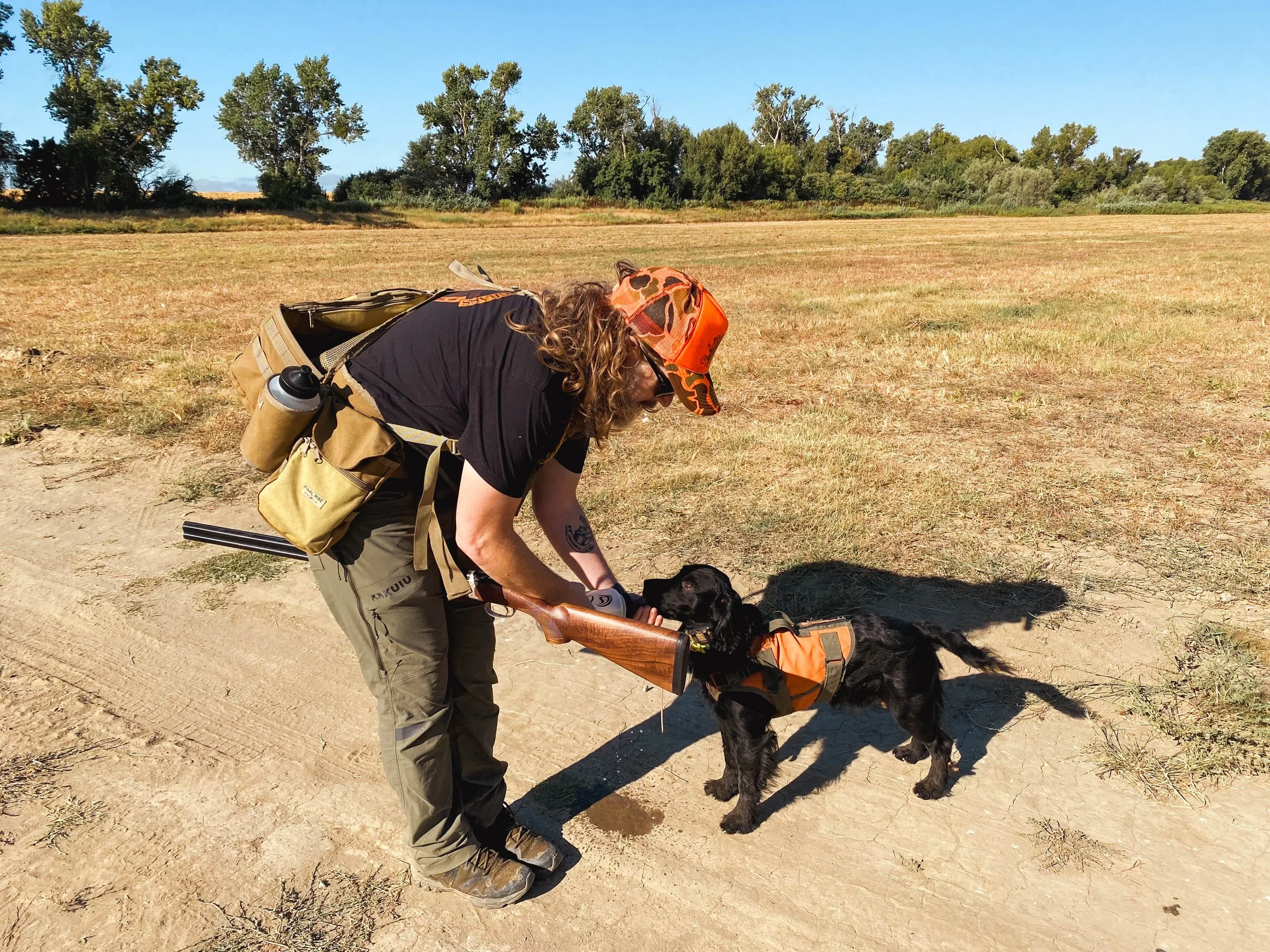
Peter and Alan on a hot dove hunt - photo by Matt Gehrmann
Last year's dove opener started at 80 degrees. First light outside Knights Landing, in the Sacramento Valley, and the truck thermometer was already reading past what most trainers would call a hard stop for real work, let alone a hunt. We worked the morning shoot as it climbed into the high 80s, then into the 90s, and called it mid-morning. Alan, my English cocker spaniel, had shade and water and looked fine — tired, but fine.
The evening shoot was the mistake. We went back out around 4 p.m. into 92-degree heat — good for doves, bad for bird dogs. Shooting stayed slow until about 5:30, right as the day was at its worst. Alan's first retrieve of the evening told the story before I could read a thermometer: flat tongue, saliva gone thick and ropy, and instead of trotting the bird back to hand the way he always does, he dropped onto his belly at my feet. I checked his gums — still pink, not gray, which brought me a little calm — gave him water, and wet down a Ruffwear Swamp Cooler neck gaiter I had in the truck bag and got it around his neck right there in the field.
I called it - even though consistent doves started showing up. Soaked his ears, groin, chest, and feet, loaded him into the car, and ran the AC the whole drive back to San Francisco. It wasn't the hunt I'd planned, but I've seen what a dog looks like on the far side of that line, and I wasn't going to find out how close we actually were.
That kind of afternoon is not rare on a California opening weekend, and it is exactly what off-season conditioning is supposed to prevent. Bird dog heat safety is not a September problem, or a July one — it is a spring problem too, and the conditioning calendar has to bend around that fact or you will hurt a good dog before the season even starts.
What Hyperthermia Looks Like in a Working Dog
A hunting dog in a hot field is metabolically a different animal from the one on your couch. Working dogs run a core temperature of 102 to 103°F at baseline; light field work pushes that to 104 or 105 within minutes. The trouble starts when the dog cannot dump heat fast enough through panting and the foot pads, usually because ambient temperature is high, humidity is high, or there is no shade or water within reach. Early signs: thickening saliva, bright-red gums, panting that sounds wet rather than rhythmic, a dog that wants to stop and lie down on its belly. Late signs: stumbling, vomiting, collapse. Past 106°F core, organ damage starts.
CDFW does not regulate when you train your dog - common sense regulates that. The honest standard most California trainers run by is straightforward: if the air temperature is above 75°F by the time you start, you have already missed the window for hard work.
Reading the Calendar
In May, sunrise lands around 6:00 a.m. By 7:30 the Sacramento Valley floor is climbing through the seventies. By nine it is in the eighties. That is your hard work window — first light to about 7:30 a.m. After that you are doing maintenance, not training. The Coast Range coastal fringe — Mendocino National Forest's western edge, the redwood-shadow of Boggs Mountain Demonstration State Forest — buys you another hour and ten or fifteen degrees of cushion. The foothills behind Auburn split the difference. The Modoc Plateau, despite its altitude, can still spike past 80°F by mid-morning in May; mountain weather is not automatic cool weather. Train where the marine layer reaches if you can.
Water, Shade, and Timing on the Run
Carry more water than you think you need. A working dog can pull two liters across a forty-five-minute run in warm weather. A four-liter bladder for the dog and a hand-held bottle for yourself is a reasonable floor. Pause when you find some shade. If the cover does not throw shade, build the run around stock tanks, creek crossings, or the truck cooler. When you cool a dog, wet the ears, chest and groin, not the back. Cooling the femoral arteries drops core temperature faster than soaking the topcoat, and on dogs with thick double coats a wet back can actually trap heat.
Cooling vests and collars like the one I use for Alan have a use, but they are not magic. Evaporative vests work in dry heat, fail in coastal humidity, and add weight a tired dog has to carry. They extend the work window by maybe ten minutes. They do not unlock midday training. If you find yourself relying on the vest to make a session work, the session probably should not be happening.
Honest Off-Season Conditioning
Pre-dawn roadwork — for me this is runs along the Embarcadero in San Francisco to keep us both in shape, but if you’re lucky it’s the dog trotting alongside a bike or four-wheeler at 8 to 12 mph for twenty to forty minutes on cool dirt — builds cardiovascular base without the heat exposure of cover work. Swimming in a foothill reservoir, the lower Yuba, or the cool tailrace below Folsom is the best cross-training a bird dog can get; it conditions every muscle group with zero impact on the foot pads. A couple swim sessions and a few roadwork sessions a week through May and June will keep a dog hard without a single field run after 8:00 a.m. Save bird contact for two short sessions a week, in cover, at first light.
A bird dog is the conservation tool that makes California upland hunting work — finding crippled birds, marking dead birds, hunting cover too thick for a person to push alone. Take care of the tool.
Internal links:
External links:
Peter Burnham grew up in Nevada hunting chukar in the Sierras and dove in the valleys and hunts behind Alan (a three-year-old English cocker). Read more → · Subscribe to the weekly digest →
