
The California Dove Hunting Guide: Where, When, and How to Hunt Mourning Dove on the September Opener and Beyond
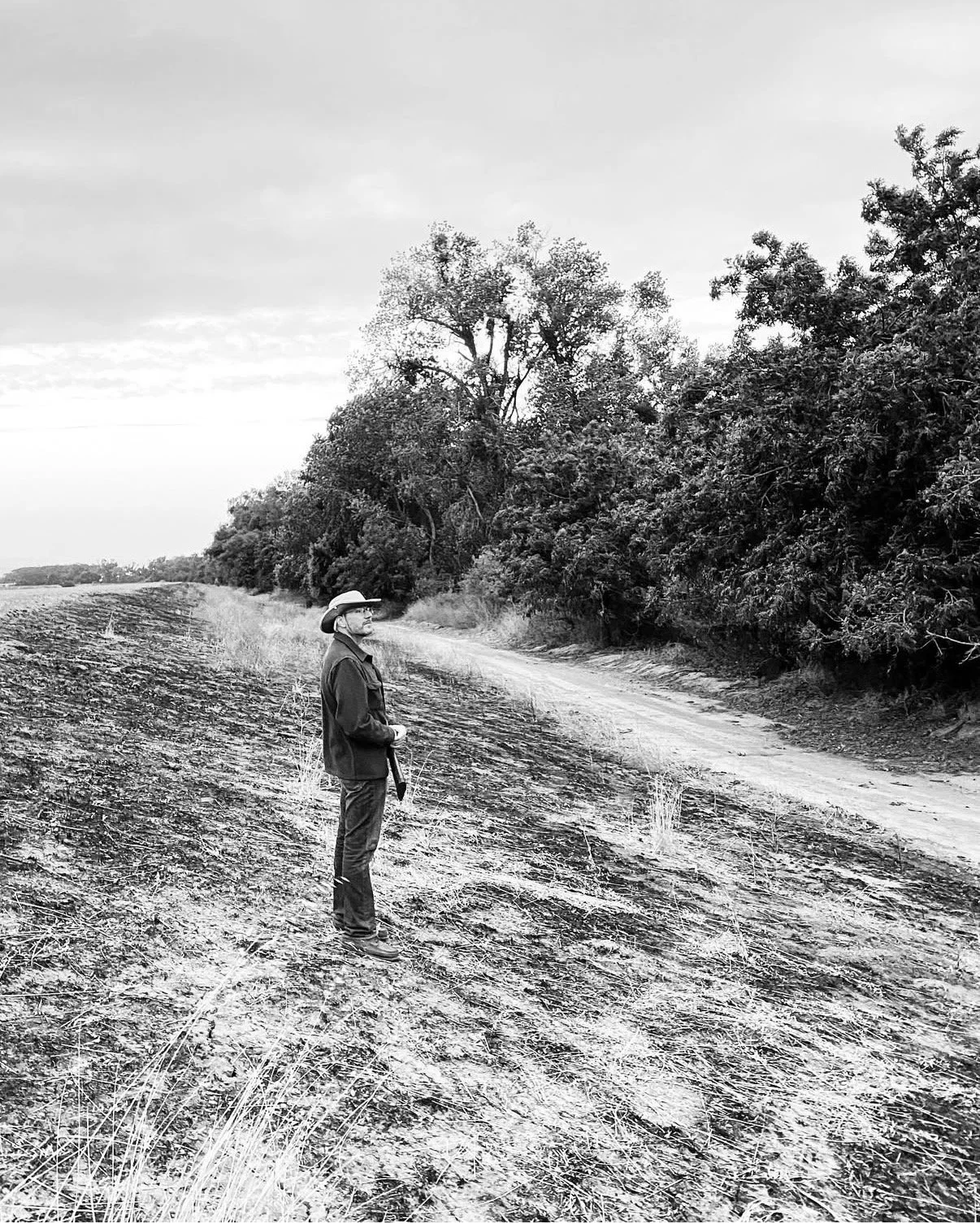
Matt waiting on doves on a rare rainy opening day - photo by Peter Burnham
September 1 is the busiest morning of the California upland year. More California hunters take the field on the dove opener than on any other day for any other species, and most of them are out before legal shooting time, parked along a turnout next to a safflower field that someone cut three days ago, drinking coffee from a Stanley and waiting for the light. It's the bird most of us cut our teeth on — Matt grew up on the Sacramento Valley side of the opener in the 1990s, riding his bicycle to public ground his dad had scouted the week before — and it's the bird that pulls the broadest cross-section of the state's hunters into the field every year. Beginners and grizzled veterans share the same field on September 1 in a way that doesn't happen for chukar or valley quail.
This is our pillar guide to hunting mourning dove (Zenaida macroura) in California. We refresh it every July before opener — the regulations, the field outlook, the public-land notes get updated then. Every California Upland dove piece links back here.
A note on scope. This guide is mourning dove. California also has hunting seasons on Eurasian collared-dove (year-round, no limit), white-winged dove (limited Imperial Valley range), and band-tailed pigeon (separate guide forthcoming — see also our published band-tailed pigeon piece). When we write "dove" in this guide unqualified, we mean mourning dove unless otherwise noted.
Know the Bird
Mourning dove (Zenaida macroura) is California's most widely distributed and most abundant huntable bird. The species nests in every county in the state, occupies habitats from sea-level Imperial Valley desert through Sierra Nevada foothills up to roughly 6,000 feet of elevation, and is the only North American gamebird that successfully raises multiple broods (up to six) per breeding season. Statewide population estimates put California's breeding mourning dove number in the millions, and the fall flight — augmented by migrants moving south from Oregon, Washington, and the Intermountain West — is one of the largest huntable bird movements on the Pacific Flyway.
The bird itself is small, fast, and acrobatic. Adults run 4 to 6 ounces, smaller than a quail. The plumage is muted — soft gray-brown back, pinkish breast in males, plainer in females, a long pointed tail edged in white that fans on landing. The flight is the give-away: a deep, fast wingbeat, the wings whistling on takeoff, and the bird typically jinking hard at the first shot. The wingbeat sound is distinctive enough that you can identify a dove approaching at 60 yards in low light by sound alone.
Doves are seed-eaters. The whole game of the September opener is finding the field they are feeding on. Mourning doves prefer small, dry, hard seeds — sunflower, safflower, wheat, milo, millet, foxtail (the same grass that menaces our dogs in summer drops seed dove will eat in September), filaree, native annual forb seed, and the broken grain from any combine pass. They feed in cycles — early morning, midday water trip, late afternoon — and they water reliably at the closest open water with a clear approach. A windmill stock tank with a bare gravel rim is a dove magnet at 4 p.m.
The migration pattern matters for the late season split. California's resident birds are gone by mid-September in most years; the November birds are migrants from the north. The two splits hunt differently because of this — the September birds are mostly local, scattered across the breeding range, and concentrate on whatever grain field is cut and waiting. The November birds are migrants in pulse-like waves following weather fronts, and they concentrate on water and on the few fields that still have standing grain or volunteer cover.
Where They Live in California
The state has four practical dove hunting regions, each with a different character:
The Sacramento Valley. Sutter, Colusa, Glenn, Yolo, Butte, Sutter Buttes, the Sacramento and Feather River corridors. CDFW Type C wildlife areas (Sacramento, Delevan, Colusa NWR, Sacramento NWR, Gray Lodge, Upper Butte Basin, Howard Slough) plus the Yolo Bypass and Sutter Bypass federal land. This is California's classic dove country — sunflower and safflower agriculture interspersed with public-land grain plantings, ample water, and the densest concentration of opener-day hunters in the state. Our planning piece on the Sacramento Valley opener and the companion field-prep piece go deeper on the region.
The Imperial Valley and Salton Sea. Imperial County in the southeast. Massive irrigated agriculture (sudangrass, alfalfa, sunflower, milo), the Salton Sea Wildlife Refuge complex (Sonny Bono NWR), and CDFW wildlife areas (Wister, Imperial). This is the under-discussed half of California dove. The Imperial Valley produces some of the highest-quality public-land dove hunting in the Pacific Flyway, particularly for the late split (mid-November through January) when northern migrants concentrate in the warm-weather agricultural belt.
The Central Coast. Monterey, San Luis Obispo, Santa Barbara counties — agricultural country in the inland valleys (lettuce, strawberries don't help dove, but the surrounding grain and bean fields do), plus the Los Padres National Forest edges. Less concentrated than the Sacramento or Imperial valleys but real bird hunting on lighter pressure. The fields are smaller and the hunters are fewer.
The statewide foothill / valley margins. Mourning dove occupies the entire state at huntable density, and a hunter with a corner of private land or a brushy edge near agriculture can find birds outside the four named regions. The Owens Valley, the Antelope Valley, the southern Cascades foothills, and the East Bay agricultural edges all hold dove in September.
Public-land options are concentrated in the CDFW Type C wildlife area system. Type C lands (most of the dove-relevant CDFW areas) are walk-in, day-use, no reservation required, and a wildlife area pass is the entry. The CDFW posts dove field plantings each summer on its Type C area maps; the maps show sunflower, safflower, and milo fields by parcel and update by mid-August.
Seasonal Patterns and the Annual Cycle
February–March. Adult birds begin pair formation. First nesting attempts in southern California; resident populations begin building.
April–August. Continuous breeding. Mourning doves raise up to six broods per season, with peak hatch in May and June across most of California. Brood survival drives the September flight density.
Early August. CDFW Type C wildlife area field plantings reach harvestable maturity. Sunflower heads ripen, safflower dries down, milo turns. The drive-by scouting window opens. The pre-opener drive-by methodology is the canonical reference.
Mid-August. CDFW publishes the final Type C field maps. Scouting intensifies. Decoys, blinds, vests, ammo all need to be ordered or staged by now; the lead-free ammo supply chain notably thins in late August (see our nonlead-ammo planning piece for the reasoning).
September 1. Opener. First split runs roughly September 1 through September 15 (verify exact dates annually). Daily bag limit is 15 dove (mourning + white-winged combined), possession limit 45. The first weekend is the highest-pressure single weekend on California public land all year.
Mid-September through early November. Closed split. No dove hunting statewide.
Mid-November through late December (approximate; verify annually). Late split. The northern migrants arrive. Best opportunity for the Imperial Valley and Salton Sea region. Bird numbers can rival or exceed opener density in good migration years.
Late January. All dove seasons close.
How We Hunt Them
We hunt opener morning and we hunt the late split, and the tactics shift between the two. Five things apply to both.
1. Scout the field, not the country. Dove hunting is field hunting. The whole game is finding the specific field that birds are using on the day you go. A scouting drive 48 hours before opener — windows down, slow speed, eyes on the field margins for sitting birds and on the air for incoming birds at 30 to 100 feet — is the single most predictive scouting effort in California upland. A field with 50 dove visible from the road at 6 p.m. on Friday is the same field that will hold birds at 7 a.m. on Sunday, weather permitting. A field with no birds visible Friday is not the field to set up on Sunday morning regardless of what the CDFW map said. The drive-by works because dove are loud and visible at a distance; you don't have to walk the field to know what it's doing.
2. Set up on the corner where birds enter the field. Doves come into a field from a predictable direction — usually the direction of the nearest water or the nearest roost cover. The corner of the field on that approach is where the shooting is fastest. Set up 20 to 50 yards back from the field edge, in shade if possible, and let birds commit to the field before shouldering. The hunter sitting in the middle of the field gets shots at 40+ yards going-away; the hunter on the entry corner gets crossing and incoming shots at 20 to 30 yards.
3. Bring water decoys and shade. On hot openers (and September 1 is a hot opener somewhere in California most years), birds water more than they feed. A four-decoy spread on a stock-tank rim or a rice-field edge is more productive than the same spread on the grain field after 10 a.m. Bring a chair, bring shade for the dog if you brought a dog, and don't move until the birds have settled into the pattern they're going to use that day.
4. Pattern the bird, not the gun. Mourning dove are small targets and they jink hard. The shooting is more about reading the bird's trajectory than about hitting the obvious spot. A bird crossing at 25 yards needs about 4 feet of lead; the same bird quartering hard away needs no lead but a high hold over the wing line. Practice on a sporting-clays or 5-stand course in August. We both shoot poorly the first weekend without it and to be honest with the practice too. Doves test skills like no other bird.
5. Don't shoot the limit on opener. This is editorial as much as tactical. Fifteen-bird limits are achievable on a good opener morning in good country and not achievable everywhere. If you're at three birds at noon, that's a successful opener for the field you're on. Push only when the country supports it. The point of a multi-month dove season is to take it across the season, not to grind out the limit in the first 90 minutes.
Dogs
Dove is one of the few California upland species where a dog is optional. Plenty of public-land dove hunters never bring a dog — they mark every shot bird, walk the recovery, and call it good. We disagree with that approach on lethality grounds (a winged bird is hard to recover without a dog), but it's defensible practice.
If you bring a dog, dove is a retrieving job. A Labrador, a golden, a Chesapeake, or any decent retrieving cocker or springer does the work better than a pointing dog does, because the shooting happens from a fixed position and the retrieves are short, quartering, and through cover that the dog doesn't need to point. Peter has run Alan on dove the last three seasons the work fits a cocker's footprint well — short marked retrieves, the bird hits cover that a flushing dog can punch through, and the September heat is the bigger obstacle than the bird itself.
Heat is the issue with a dog on the dove opener. September 1 in the Sacramento Valley regularly hits 100°F by noon. Water on the dog (the cooling vest is in the kit), pre-cooling the dog before the run, and stopping the work at 10 a.m. before the heat ramps are the protocol. A heat-stressed retriever is a vet visit waiting to happen. The same conditioning logic from our heat-safety piece (forthcoming July refresh) applies.
Gear
Shotgun. A 12-gauge or 20-gauge semi-automatic is the most common opener gun. Improved cylinder or skeet choke. Shots are 15 to 35 yards typical. A pump or a double works fine; the semi-auto wins for the volume the opener can produce. A 28-gauge is doable but loses meaningful pellet count at range.
Shotshells. Lead-free is required on every Sacramento Valley CDFW wildlife area and on every other public land statewide. Steel 7½ or 8 in a 1-ounce 12-gauge or 7/8-ounce 20-gauge is the workhorse. Bismuth 7s pattern softer and recover wounded birds at slightly higher rates but at 3× the cost. Order in July or early August — the lead-free supply for California is unreliable past mid-August.
Vest or strap rig. A strap vest with a decoy pouch and bird carrier is more comfortable than a full vest in opener heat. Final Rise, Tom Beckbe, Filson Strap. The vest you'd wear chukar hunting is overbuilt for dove.
Decoys. Four to six Mojo or spinning-wing decoys cover a field corner. Strict CDFW regulations limit motorized decoys in some refuges — verify. Static dove decoys (clip-on plastics) work as accent setup. The investment is small and the conversion is high.
Chair, shade, water. Don't underestimate any of the three. A low folding chair, a wide-brim hat or pop-up blind, three liters of water for the hunter.
Calls. Optional; mourning dove calls work in the right hands but most opener hunters don't bother. A whistle to recall the dog is more important.
Regulations You Have to Know
Re-verify every year against the current CDFW migratory bird hunting regulations. What's here is the 2026-27 outlook; always confirm exact dates and limits in the CDFW migratory bird hunting digest before opener.
License + Upland Game Bird Validation ($10 stamp). Funds California upland habitat work — see our upland-stamp piece.
HIP validation required. Federal Harvest Information Program. Free, available through CDFW License Sales, valid one license year. Required for dove, band-tail, snipe, and any other migratory bird. The most-missed step among California opener-day hunters. Get it in August, not at 5 a.m. on September 1.
Daily bag limit: 15 dove (mourning + white-winged combined). Possession limit 45.
Nonlead shot required statewide (AB 711). No exceptions.
HIP-required species not bagged separately: Eurasian collared-dove is not counted in the 15-bird limit and is year-round, no daily limit. White-winged dove and band-tailed pigeon have separate dates and limits.
Hunting hours: half hour before sunrise to sunset.
First split: typically Sept 1 through Sept 15 (verify annually).
Second/late split: typically mid-November through late December for most of the state; verify the Imperial Valley dates separately as the southern Pacific Flyway zone has historically run on a slightly different calendar.
Wildlife area passes required on Type C areas. Annual or daily. The annual pass is the right buy if you'll hunt more than three days a year.
Conservation: Habitat, Water, and the Quiet Pacific Flyway Bird
Mourning dove are one of the great quiet conservation success stories of the 20th century. North American populations have stayed stable or grown over the last fifty years despite massive habitat conversion in the breeding range, largely because the species adapts well to agricultural and suburban landscapes. They are not in trouble.
What is in trouble is the public-land infrastructure that makes California dove hunting accessible. CDFW Type C wildlife areas — the public ground where most California opener-day hunting happens — require annual funding for field plantings (the sunflower, safflower, and milo strips that draw birds to the parcel rather than to the adjacent private agriculture). When CDFW's budget is squeezed, the field plantings shrink, and the next opener's public-land hunting suffers. The upland stamp partially funds this work, but waterfowl funding (federal duck stamps, state waterfowl validations) does the heavier lift.
The two practical conservation moves for a California dove hunter:
Buy the upland stamp and the state duck stamp every year. Even if you don't hunt waterfowl. The duck stamp funds the wetland infrastructure that the dove sit on top of, and dove benefit from every acre of wetland habitat work the waterfowl funds buy.
Show up for one CDFW wildlife area workday. Pheasants Forever, California Waterfowl, and CDFW co-organize volunteer days each spring and summer for planting, weed control, and infrastructure maintenance. One Saturday in May is the cost of admission to a publicly-funded dove opener the rest of your life.
How to Use This Guide
This is the cornerstone — the canonical link target. Every California Upland piece that touches dove links back here, and we link out from here to the specific opener-planning, field-prep, scouting, ammo, and regulation pieces that go deeper on each angle. We refresh this guide in full each July; the regulations, the Type C field outlook, and the public-land notes get updated then.
If you came in through the search results, the next reads to make use of this:
Planning a Sacramento Valley Dove Opener: What NorCal Hunters Should Do Now
Sacramento Valley Dove Field Prep: A Pre-Opener May Drive-By Method
Nonlead Ammunition for California Upland Hunters: 2026-27 Supply Planning
Your Upland Stamp at Work: How California's $10 Validation Funds Wild Bird Habitat
If you want the weekly digest that puts new field reports and planning pieces in your inbox each Sunday — and the California Upland Season Dates & Limits Cheatsheet as a thank-you — the subscribe page is the place.
The opener is in 43 days. The work between now and then is the scouting drive in mid-August, the HIP validation in late August, the lead-free shells ordered in July, and the chair-and-shade kit packed the night before. The bird will be there. The bird is always there. Show up early. Good hunting.
— Matt & Peter California Upland
Matt Gehrmann grew up hunting the Central Valley for pheasant, quail, and dove, and is based in the Bay Area. Read more → · Subscribe to the weekly digest →
Peter Burnham grew up in Nevada hunting chukar in the Sierras and dove in the valleys and hunts behind Alan (a three-year-old English cocker). Read more → · Subscribe to the weekly digest →