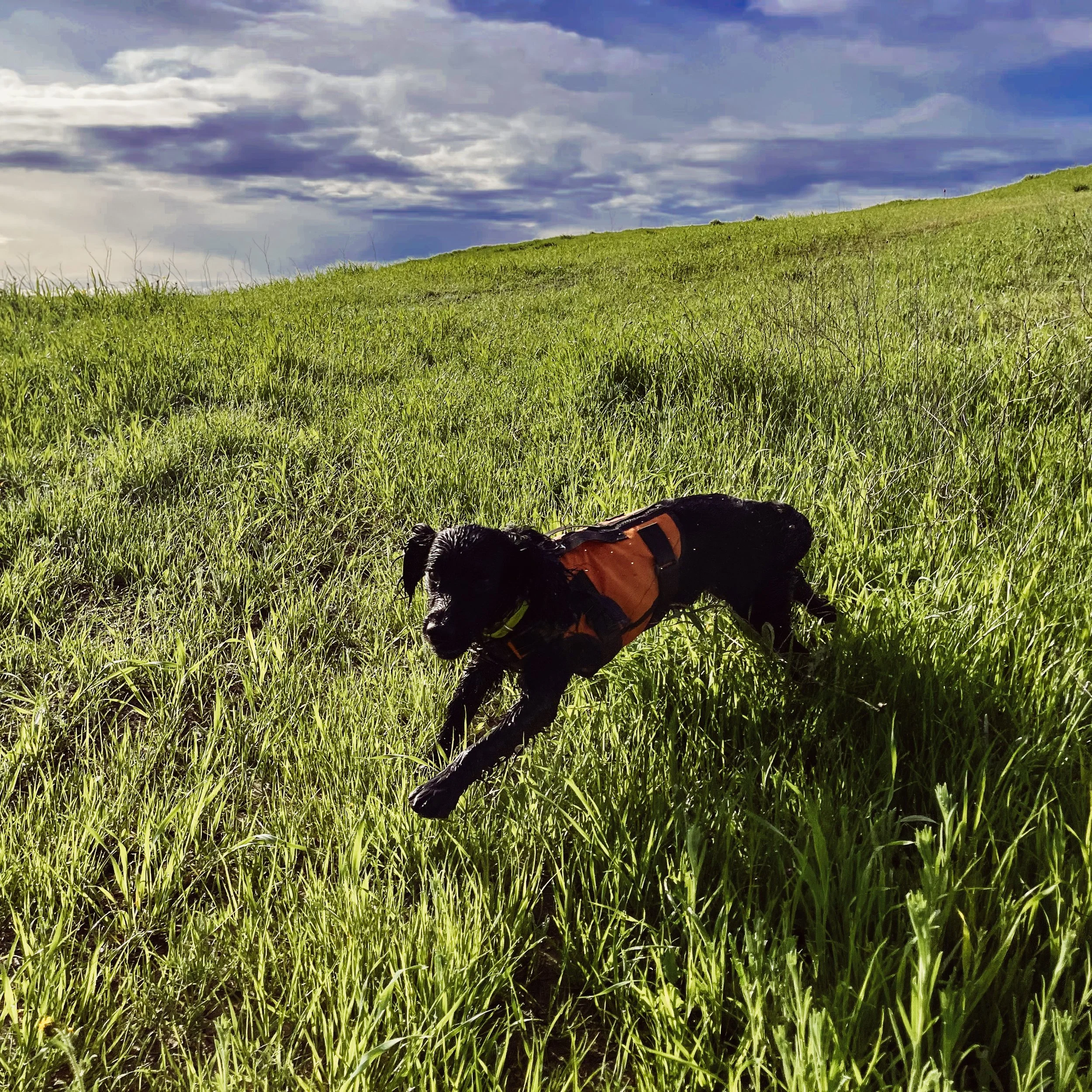
Alan hunting CRP - photo by Peter Burnham
Three seasons in with Alan, the biggest thing I've gotten better at isn't gear or scouting or shooting. It's paying attention to him. I'm still figuring it out, but I've started to notice what he's telling me a few seconds before the bird shows up, and it's made a real difference.
A dog working cover gives off a lot of information. Tail, shoulders, ears, how fast he's moving, how he's angled into the brush. For my first season or so I missed nearly all of it. I walked behind Alan, waited for something to happen, and was usually caught flat-footed when it did. The hunters I look up to seem to read their dogs constantly and adjust on the fly, and I've been trying to get there.
Here's what I've picked up so far. Big caveat: these are Alan's habits, not rules. A wide-running pointer is going to look different, and so is a Lab. What I think carries over is the habit of watching your dog first. The specific signs probably won't.
## Start With What Normal Looks Like
I didn't figure this out until my second season: you can't notice a change if you don't know what the dog looks like when nothing's going on. Now I spend the first ten minutes of a hunt just watching Alan when there aren't any birds around.
Here's Alan's normal. He's nose down, almost always, with quick glances back at me and out toward the terrain ahead. His tail sits around half-mast and swings in a steady rhythm. His shoulders are loose, his ears are alert but not pricked, and he covers ground without any urgency.
Everything below is a change from that.
## The Tail Is What I Watch Most
If I could only watch one thing, it would be the tail. It's the easiest part for me to read, and I'm still learning the rest.
Slow, low, steady wag: nothing yet. He's working scent, but not committed. I try not to get excited and I stay out of his way.
Tail comes up and the wag speeds up: he's found something but hasn't placed it. This is where I've learned to slow down, get my shotgun ready, and let him sort it out instead of pushing forward.
Tail vertical and going fast: a bird is close, and Alan knows it. For me this is the "get ready now" signal. When he's within about fifteen yards of a covey, his tail goes from a steady wag to a vertical blur in roughly three seconds. I've missed more than one rise because I wasn't set by the time that happened.
Tail goes still mid-stride: he's committing, and the bird is about to go up. I try to get into a spot where I can see the likely line of flight, hold the gun ready, and mount once the birds are clear of the cover and Alan's out of the way.
I know pointing dogs run on a different code, and people who hunt behind them read the tail differently. I can only speak to Alan.
## Pace Changes Are Harder to Notice
How fast and how steady Alan is moving through cover is the thing I miss most often, because it shifts gradually. There's no single moment where it jumps out at you.
Cruising along, relaxed, covering ground: I take it to mean no birds nearby.
Speeding up and circling tighter, going over the same patch from a couple of angles: there's scent around but he hasn't pinned it down. I've learned to hang back about ten yards and let him work.
Suddenly slowing, placing each foot carefully: the scent is fresh and he's closing in. I've bumped birds by crowding him here, so now I just stop and stay ready.
Sudden burst of speed: either he's bumped the bird and it's about to go, or he's decided to commit and charge the flush. Either way I mount as soon as the bird clears.
## Different Birds, Different Looks
After three seasons, I can sometimes tell what Alan's on by how he's working. I'm not always right, but I'm right more than I used to be.
California quail covey: slow and methodical in a tight patch of brush, with the tail climbing steadily. A pinned covey leaves a lot of scent, so Alan seems to be sorting out exactly where they are. When they go, it's the whole covey at once, twenty or thirty birds, so I'm ready as soon as the tail starts climbing.
Singles after the covey flush: much quicker and with tighter circles. Singles run a few feet, sit, and leave less scent, so Alan works them fast and I usually get one or two birds going up at a time.
Downed dove in heavy cover: I didn't expect this one. Alan works a downed dove like a wounded quail, slow and focused with deliberate footfalls. When I see that, I stay out of his way. He's found birds I'd never have found on my own, usually in under a minute.
## Sometimes He's Telling Me There's Nothing There
This is the one I resist. When Alan covers a stretch of country with a relaxed wag and no change in pace, there's probably nothing in it. I've learned to move on instead of working the same ground over and over.
I think a lot of us want to believe our favorite spot is holding birds. Alan doesn't care what I want to believe. Trusting him when he says a piece of cover is empty has saved me a lot of walking.
## What's Helped Me Get Better
Two things have made a bigger difference than I expected.
Hunting alone with Alan a few times each season. When I'm with other hunters I'm talking, I'm watching their dogs, and I stop watching mine. Solo, I have to pay attention to Alan the whole time, and that's where I've learned the most.
Talking to other handlers about their dogs. Everybody's dog has different tells. Hearing how someone reads their setter, or their Lab, or their Brittany, gives me more to look for in my own dog.
I'm three seasons in and still learning Alan. I suspect the dog who lives with you and hunts with you for ten years will teach you more than any article, this one included. If you want a place to start, spend ten minutes at the beginning of your next hunt just watching your dog before there are any birds around.
What Alan carries in the truck, and why, is its own piece. The country this reading gets used on is in the valley quail cornerstone.
Peter Burnham grew up in Nevada hunting chukar in the Sierras and dove in the valleys and hunts behind Alan (a three-year-old English cocker). Read more → · Subscribe to the weekly digest →
