
The California Valley Quail Hunting Guide: Where, When, and How to Hunt Callipepla californica
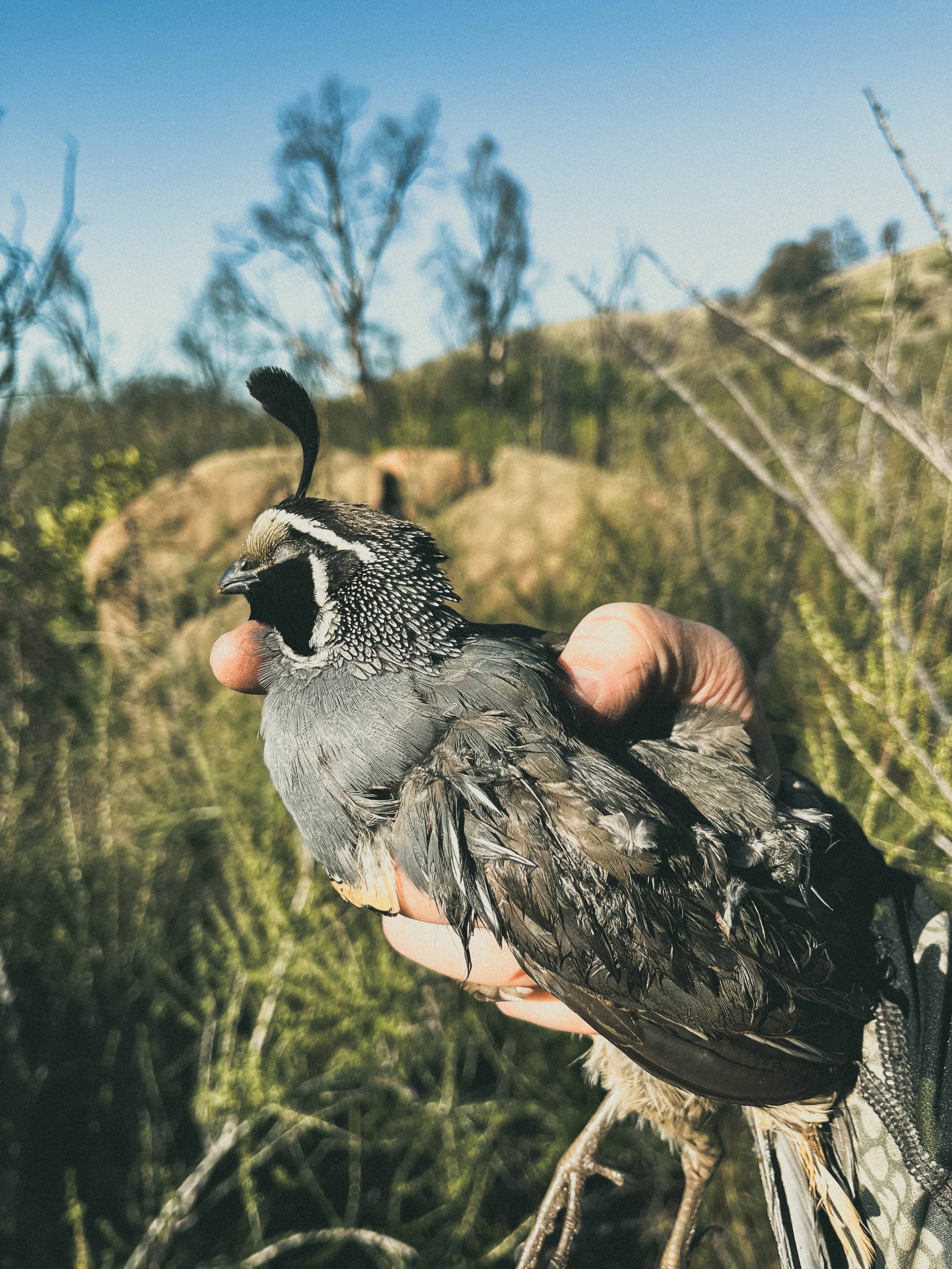
Quail in hand - photo by Peter Burnham
The first covey rise of the season is one of the great moments in California hunting. Twenty or thirty birds erupt from a tangle of chamise at boot height — a sound like a deck of cards thrown into a fan, the whole world going sideways at once — and even after twenty seasons we still occasionally stand slack-jawed and watch them go. The California valley quail (Callipepla californica) is the most widely hunted upland bird in the state, and the most under-respected. People treat them as a bonus bird, something you stumble into while driving a dirt road, and that habit is the reason most California quail hunters leave the field with fewer birds than the country deserved to give up.
This is our pillar guide to hunting them — the one we'll refresh every July before the opener, and the one every other valley-quail piece on this site links back to. If you read one thing on California Upland about Callipepla californica, this is it.
Know the Bird
The California quail, also called the valley quail, is California's state bird and the most numerous upland game bird in the western United States. The species runs the length of California from the Oregon line to the Mexican border, with a separate desert congener (Callipepla gambelii, Gambel's quail) in the southeast and an upland congener (Oreortyx pictus, mountain quail) in conifer mid-elevations. Valley quail are the only California Callipepla that combines abundance, ubiquity, and willingness to live near agriculture. They are what most California upland hunters mean when they say "quail."
A mature male carries the species' signature plumage — chestnut crown, white face stripe under a black throat, the gray-brown body, and the forward-curving teardrop topknot of three or four plumes. The female is plainer but has the same topknot, smaller. Both sexes are plump, ground-bound for most movement, fast in the air for the short hundred-yard glides that connect cover patches.
Coveys assemble from late summer through fall as broods consolidate. By the October opener, a healthy covey runs 20 to 40 birds; in a wet-spring year following good rainfall (see our piece on spring rainfall and chick survival) those numbers can push 60. Birds are gregarious year-round and intensely social on the ground. The "Chi-ca-go!" three-note assembly call — males, usually from an elevated perch — is one of the most useful sounds in the upland hunter's vocabulary. If you can hear it, you can work toward it.
Daily rhythm is predictable. At first light, coveys drop from their roosts (dense shrubs and oak limbs four to seven feet off the ground) and begin feeding along open edges. By mid-morning they retreat into loafing cover — the thickest stuff in the area — and may stay there for two or three hours unless temperatures push them to water. Late afternoon brings them out again; an hour before sunset they're back at the edges, then back up into the roost. The hunting windows are the first two hours of daylight and the last ninety minutes before sunset. The middle of the day is for stopping, listening, and moving deliberately toward the assembly call you hear, not for crashing brush.
Where They Live in California
Valley quail occupy a broader habitat envelope than most hunters realize: oak savanna, chaparral, foothill grassland with shrubby edges, riparian corridors, the margins of dry-farmed grain fields, post-fire regrowth, and (more rarely) the brushy edges of Central Valley agricultural land. The connecting thread isn't a single plant community — it's structure. Quail need three things in proximity: overhead concealment to hide in, thick escape cover to flush into, and open ground to feed across. They are edge birds. The best California quail country is a mosaic of all three within a hundred-yard pivot.
The strongest densities and best access run through five distinct regions:
The Inner Coast Range. The eastern flank of the Mendocino National Forest, the Cache Creek BLM Coordinated Resource Management Area, Cow Mountain Recreation Area (both north and south units), Knoxville BLM, and the Berryessa Snow Mountain National Monument — chamise-and-oak country at 800 to 3,500 feet, intercut with grass and the occasional serpentine bald. Access is largely public, mostly walk-in from M-series and dirt roads. This is the best concentration of valley quail on big public dirt in NorCal, and it's where we hunt them most often. The post-2017 burn scars in Lake and Napa counties have produced phenomenal regrowth quail habitat — see our piece on reading young burns.
The Sierra Nevada foothills. The northern foothills from Yuba County north through Tehama and Shasta, in oak woodland and chaparral at 500 to 2,500 feet. Birds are well distributed but pockets are easier to find at the elevation breaks — oak-to-chaparral transitions, drainages cutting between cover types, the upper edges of cleared rangeland. Access mixes BLM, USFS (Mendocino, Plumas, Lassen), and private hunting leases.
The Sacramento Valley edge. The brushy bench above the rice ground, the riparian corridor along the Sacramento and Feather rivers, and the foothill-meets-valley transitions on the east and west sides of the valley. Smaller coveys, more pressured, but accessible — and you'll often find them on the same scouting drive that turns up dove and pheasant ground.
The Central Coast and Los Padres country. From Monterey County south through San Luis Obispo and the inland edge of Santa Barbara, valley quail mix with the southern oak woodlands and chaparral. Public access runs through the Los Padres National Forest (multiple districts) and CDFW wildlife areas. Lighter pressure, smaller average coveys, but quality public-land hunting that Bay Area and SoCal hunters can reach in a day.
The Southern California foothills. The brushy edges of the San Gabriels, San Bernardinos, and inland Cleveland National Forest hold valley quail (sometimes overlapping with Gambel's at the eastern desert edge). The country is steeper and the access is patchier, but where you can park and walk, the birds are there.
Within any of those regions, the template doesn't change. Valley quail need water — within roughly a quarter mile of a spring, seep, stock tank, or seasonal creek for most of the season — and they need that mosaic of overhead and escape cover and feed. Burn scars three to five years old are arguably the most underutilized habitat in California; the young brush, the increased seed and insect production, and the structural patchiness all favor quail. The 2018-2022 burn footprint across the Inner Coast Range, the Sierra foothills, and the Los Padres is where a lot of the next decade's best valley quail hunting will happen, if we don't lose it again to fire before the cover matures.
Seasonal Patterns and the Annual Cycle
Quail biology runs on a tight calendar that gives the hunter a roadmap for the whole year:
January–February (post-season). Coveys persist but are pressured. Wintering birds concentrate around water and dense cover. Off-season scouting begins.
March–April. Coveys begin breaking up. Pair formation; males stake out calling perches. Spring rainfall determines the year. Heavy March-April-May rain produces grass-seed and insect crops that translate directly to chick survival in June-July. A wet spring is a strong covey year five months later; a dry spring is a thin season.
May–June. Nesting peak. Hens lay 10–16 eggs in a ground scrape under shrub cover. This is when "Hands-On Habitat Month" matters — every BLM and Quail Forever volunteer hour spent on guzzler maintenance, brush mosaic work, or grass restoration pays into the coming covey count.
June–July. Chicks hatch and broods begin moving. This is the most vulnerable life stage: predator pressure, weather, and dry-down all kill chicks. Brood survival is the single biggest year-over-year variable in California valley quail populations.
August–September. Broods consolidate. Hunting-season coveys form. This is also when we drive the country to listen for assembly calls — the audit of a new piece of country starts here, six weeks before opener.
October. Season opens (verify exact dates each year against the current CDFW upland regulations; season has typically opened mid-October statewide, with a slightly earlier opener in the mountain quail zones). Coveys are at their largest, birds are inexperienced, and the country still has cover and water from the prior season. Best two weeks of the year for new hunters.
November–December. Coveys thin but the survivors are wise. Hunting gets harder, ranges open up, and the bird-and-dog quality goes up.
Late January. Season closes (typically late January; verify annually).
How We Hunt Them
We hunt valley quail differently depending on the country, but five rules apply everywhere.
1. Lead with your ears. Before you crash brush, stop. Two minutes of standing still and listening will tell you where the coveys are and roughly how many. If you hear the assembly call, mark the direction and the distance and approach from downwind. If you don't hear anything for ten-fifteen minutes at a likely spot, you're probably in the wrong cover.
2. Hunt the edges, not the middle. Birds are most often in the transition: open grass into the brush, the lower edge of the chaparral, the seam between oak and bunchgrass, the rim above a stock tank. Pushing into the center of dense cover often runs birds out the far side wild and out of range. The dog works the edge; the hunter walks the next concentric edge outward.
3. Don't overrun the dog. California valley quail are excellent runners. A covey that hears a hard-charging dog will leg it a hundred yards before flushing, often through cover the hunter can't follow. Slow the pace. Pointing dogs need room to read scent in chaparral and bunchgrass; flushing dogs need to work close enough that the inevitable bumps happen in range. We've made every variant of this mistake.
4. Work the singles after the covey flush. The initial flush is chaos — birds going twelve directions at once, fast and low, usually into the thickest cover available. Take a clean shot if it's there. The real opportunity is the next twenty minutes. Scattered birds immediately start calling and moving toward where the others went down. They're focused on regrouping, not on you. A dog can pin singles tight; the shots are cleaner; you can build a real hunt on those second-half birds.
5. Read the country the off-season told you to read. The scouting work you did in April, May, and August is what makes October pay. Drive in spring and listen for assembly calls from males on perches. Mark water, mark cover-to-grass transitions within a quarter mile of each water source, and mark the brush-to-burn-scar edges where the regrowth has come back. By August, the curing grasses will show you the structure. By October, you'll know which 200 acres to walk first.
Calling matters. A handheld quail call (Faulk's, ACME), or a phone app broadcasting the assembly call (sparingly — and never to push birds onto private land or out of refuge boundaries) will get coveys to answer you. In the off-season this is how we audit new country: drive the dirt roads at last light, stop, call, and listen. Replies mean birds.
Dogs
This is the bird-dog state. We're not going to tell you which breed to run, because the breed matters less than the way the dog and the country and the hunter work together. But two things are true for California valley quail specifically.
First, close-working pointing breeds and flushing breeds both work. English cocker spaniels, Brittanys, French Brittanys, German shorthaired pointers, English setters, and Labrador retrievers all have devoted California valley-quail hunters behind them. Big-running pointers can work if the handler has the country and the bell-to-collar communication for it; for most of us, a 50-to-150-yard cast in chaparral is the right shape. The pointer that works close, holds tight, and breaks honest is the pointer that thrives here.
Second, the brush is brutal on dogs. Chamise, manzanita, scrub oak, ceanothus — all of it abrades, all of it hides foxtails and ticks, and a season's worth of running takes a toll. Conditioning starts in May. First-aid kits live in the truck (see our field first-aid piece). Foxtail prevention isn't optional. We do a full body check, feet and ears and gum-line, every night.
The dog story is half the reason most of us do this. The piece linked above on field first-aid is the practical companion; for the longer arc of a dog's career on California cover, our Dog Stories archive is where we write that out.
Gear
Valley quail are forgiving on gear and unforgiving on shoes. The right kit philosophy: spend on what touches the ground (boots, the dog's collar, pants that can take chaparral) and the bird (shells); save on the rest.
Shotgun. A 20-gauge or 28-gauge double or autoloader is the sweet spot. Improved cylinder, skeet, or light modified choke. Shots are short — 15 to 25 yards is typical, with the occasional 35-yard going-away — and patterns need to be open, not tight. A 12-gauge works fine; a 16-gauge is a beautiful tool if you have one.
Shotshells. California has required nonlead shot for all hunting since 2019. For valley quail, our load is bismuth 7½ in a one-ounce 20-gauge or a 7/8-ounce 28-gauge. Steel 7s work but pattern slightly tighter and need more choke compensation. Tungsten Super Shot in #9 is overkill on price but unkillable on patterning. See our nonlead-ammo planning piece for the supply-cycle reasoning.
Vest. A strap vest (Final Rise, Kuiu, Chief Upland) wins for hot foothill weather and a 10-bird limit. The bird pouch needs to be big enough to carry the limit without sitting on the small of your back.
Pants and chaps. Brush pants are not optional. Filson Shelter Cloth, Kuiu Attack, Tom Beckbe Tensaw, or proper chaps (Cabela's, Dan's Hunting Gear) over lighter pants. See our brush-pants gear guide.
Boots. Eight-to-ten-inch leather uppers with a stiff midsole. Crispi Wyoming, Russell Zephyr, Kenetrek Hardscrabble. Granite dust, decomposed serpentine, and the kind of side-hilling chaparral country we hunt is rough on cheap boots. The Crispi/Russell tier is worth it.
Calls and tools. Faulk's quail call, a Garmin collar on the dog, a topo map of the cover you're hunting, and more water than you think you need — for you and the dog.
Regulations You Have to Know
This section gets re-verified every year against the current CDFW upland regulations. What's here is the 2026-27 outlook; always confirm exact dates and limits in the CDFW upland game regulations booklet before opener.
License + Upland Game Bird Validation ($10 stamp). The validation directly funds California upland habitat work — see our upland-stamp piece.
Daily bag limit: 10 quail in any combination of California, mountain, and Gambel's. Possession limit 30.
Nonlead shot required statewide (AB 711). No exceptions for upland.
HIP validation not required for quail (it's required for any migratory bird — dove, band-tail).
Hunting hours: half hour before sunrise to sunset.
Season dates: typically mid-October through late January statewide. Mountain quail zones may open slightly earlier in some years.
Conservation: Where the Birds and the Money Live
Public-land valley quail are public-money birds. The $10 California upland stamp funds CDFW's Upland Game Bird Habitat Improvement program, which has built guzzlers, brush mosaic complexes, and seed-strip projects across BLM Inner Coast Range parcels, Sierra foothill USFS units, and Sacramento Valley CDFW wildlife areas. Quail Forever's California chapters and Pheasants Forever (joint chapters in CA) put volunteer hours into the same projects through Hands-On Habitat Month each May.
The two big long-term threats to California valley quail are fire and drought. Fire is a double-edged sword — bad fires erase cover, but young burns produce some of the best quail habitat in the state. The mature-chaparral monoculture that grows in the absence of fire is worse habitat than a recently burned mosaic. The conservation conversation is increasingly about managed fire — prescribed burns, fuel breaks that double as habitat enhancement — and that conversation needs hunters at the table. The CDFW-USFS-BLM coordination on post-fire habitat work is exactly the kind of thing the upland stamp helps fund.
Drought matters because water concentrates birds. A drought year compresses coveys onto remaining water sources and makes them more vulnerable. The wildlife guzzler network is increasingly the difference between a sustained population and a population crash in a multi-year dry stretch.
If you hunt valley quail, the practical conservation things to do are: buy the upland stamp every year (not just license renewal), join Quail Forever, show up for one Hands-On Habitat Month workday in May, and write to your CDFW regional commission representative when habitat funding is on the agenda. The 30 minutes spent doing any of those is more leverage than another 30 minutes scouting.
How to Use This Guide
This is the cornerstone — the canonical link target. Every California Upland piece that touches valley quail links back here, and we link out from here to the specific scouting, gear, dog, conservation, and field-report pieces that go deeper on each angle. We refresh this guide in full each July; the regulations, the burn-footprint references, and the recent field-report citations get updated then.
If you came in through the search results, the next reads to make use of this:
Reading the May Greenup: What Bunchgrass Tells You About Fall Valley Quail
How Spring Rainfall Shapes California Valley Quail Chick Survival
Nonlead Ammunition for California Upland Hunters: 2026-27 Supply Planning
Your Upland Stamp at Work: How California's $10 Validation Funds Wild Bird Habitat
If you want the weekly digest that puts new field reports and planning pieces in your inbox each Sunday — and the California Upland Season Dates & Limits Cheatsheet as a thank-you — the subscribe page is the place.
The birds are there. They've always been there. The work is in showing up — in May for the habitat day, in August for the listen-and-drive, in October for the covey rise, and in December for the singles that hold tighter than the covey did. Good hunting.
— Matt & Peter California Upland
Matt Gehrmann grew up hunting the Central Valley for pheasant, quail, and dove, and is based in the Bay Area. Read more → · Subscribe to the weekly digest →
Peter Burnham grew up in Nevada hunting chukar in the Sierras and dove in the valleys and hunts behind Alan (a three-year-old English cocker). Read more → · Subscribe to the weekly digest →